No doubt, dear reader, you are wondering if I have totally flipped my lid with that title but not quite, although last Thursday evening I did (that was the greeen, luminescent cloud over Torremolinos around 23.10h). As that well known Scottish poet, Robert Burns, he so beloved of the true Russian communists before perestroika (= prehistory now) as expressing feelings of the down-trodden Scottish worker living on mashed tatties and bashed neeps, wrote, 'The best laid plans of mice and men gang aft agley.'
This is all written in the vernacular so you'll have to work it all out for yourselves, but at 23.10 last Thursday evening, after spending the end of a long hour writing up two days' birding down at the Guadalhorce, hit the wrong button and instead of publishing it I deleted my efforts and I did not extend myself to saying 'Oh dear me.' Not flipping likely, I gave it the full range of my vocabulary, had a shower and sacked out.
It was impossible to get it done Friday and Saturday wasn't any better, so herewith a resumé of Wednesday, 05 September, down at the Guadalhorce with Federico, followed by another of the Thursday at the same place with Sandra, and to finish it all off, there will be a note on the trip that Federico and I made to Fuente de Piedra on the Friday morning. So, fasten your seat belts and off we go, although the entries for each will be brief.
04 September - Guadalhorce with Federico. The first Cormorant of the season welcomed us and Grey Heron numbers had reached double figures. There were still reasonable numbers of both Pallid and Common Swifts around and both Barn Swallows and House Martins were hanging on in there too. A couple of European Turtle Doves made fast, now-you-see-me, now-you-don't, which is hardly surprising given the persecution they suffer. Reed Warblers are moving through and we sawe and heard three or four. Ducks species were much the same as usual with nothing outstanding although there were 2 early Teal which zipped out at high speed.
This autumn the Guadalhorce really is being quite dire for waders with few in species and numbers. After all, one really can not get too worked up about 3 Little Stints, 2 Common Sandpipers and 2 Redshanks with a single Turnstone was investigating a dried tussock on the laguna Grande. And while I like the small plovers, I'm getting just a bit bored with 38 or so Little Ringed and 7 Kentish. Gull numbers are much the same and while LB-bs are going up in number, Audouin's are going down, as are Mediterranean, whilst Black-headed remain fairly constant.
Total = 41 species.
05 September - Guadalhorce with Sandra. Locking the car keys in the car inside my rucksack did not make for an auspicious start and the total of species seen appeared to follow the trend, And it's not even the Ides of March! Little Ringed Plover numbers had fallen to 31and I forgot to count Kentish Plovers, but there can't have been more than 5 or 6. Dunlin numbers had halved 1 and Little Stints had fallen to 2. On the plus side there were actually 3 Redshanks and a single Spotted Redshank - this probably being the bird of the day whilst the Turnstone was still investigating the same dried tussock - it can't have been there all the time since the previous day, or can it? On the other hand, Common Sandpipers had risen to the dizzy heights of 4.
A Kingfisher did a single fast, low-level pass and was gone, whilst 2 Booted Eagles circled lazily around. With the addition of 2 or 3 Red-rumped Swallows, delightful birds, the swifts and swallows were much the same as the previous day.
Oh yes, I got home as my daughter's companion went to my place, got the spare car key and brought it out to me. He has gone up in my estimation.
Total = 28 species.
06 September - Fuente de Piedra with Federico. Bonb had been up to Fuente on Wednesday and reported lots of waders and variety on the large dried out pond behind the information centre, so we hied ourselves up there. The lake itself still has lots of water and is full of flamingos, mostly adults but with quite a lot of chicks. I have never, ever, in the 30 or so years, seen so many birds there, perhaps 30.000 or more? all spread out as far as the eye can see. It is worth a visit and is quite eye-catching, reminding one of photos of lakes in the Rift Valley.
As for other things, we had a juvenile Marsh Harrier, which was nice to see, as well as 3 Spoonbills and a juv,. and adult Night-heron. There were quite a few Shovelers on the laguna and also Black-necked Grebes and Coots all probably a portent of the numbers to come. Then it was time for the waders.
I didn't do much of count as the main troubkle with the hide that overlooks the laguna t the back, the pantaneto del Pueblo, is that in the morning one is looking into the sun and it is undoubtedly better for observation later in the day when the sun has gone round. However, that apart, we notched up 12 species of waders, which makes a nice change from 6 or so at the Guadalhorce: Avocet, Stilt, LRP, Lapwing, Snipe, Dunlin, Little Stint, Curlew Sandpiper, Green Sandpiper, Common Sandpiper, Black-tailed Godwit, Ruff. Well worth the trip and we finished off with a Melodious Warbler.
But do, if you have the time, go and have a look at the lake. It really is quite stunning.
Other news. Friday saw a huge passage of Honey Buzzards down in the Strait with some 20.000 logged going over to Africa. Dotterel have also been recorded on thre Los Lances beach last week. Closer to home, I had my first Pied Flycatcher of the autumn in the garden yesterday (07/09) and the Spotted Flycatcher is still around and the Rose-ringed Parakeets have returned after a summer sabbatical.
Finally, my sister has just rung from the beach south of Bridlington, East Yorkshire, to report Ostercatchers and a Lancaster bomber about which latter she got terribly excited.
I am now going to take great care and press the 'publish' button. Wish me luck as I press this goodby .....

4/9/13
4 September : Sierra María
I agree, Dave, and perhaps we can look forward to the weather cooling down a bit. I was at the Guadalhorce today and shall be tomorrow, so all you unlucky folks can look forward to a double dose! Friday I hope to be at Fuente de Piedra as Bob tells of good numbers and variety of waders on the lake behind the information centre. And as Fuente de Piedra = flamingos, there are still plenty of those and it looks as though one of our 2 juvenile Lessers from this year has turned up at Gallocanta (Zaragoza) as it was seen there on 29 August (E. Pelayo in rarebirdspain). Just like starting autumn term at school, isn't it?
 After our enforced summer break it was good to be
back in the birdwatching saddle. Gilly, Ros and myself met up the
Trevor, Ann, Colin, Sandra, Rod and Linda at the garage cafe in María
for a coffee before heading up to the chapel. We'd already seen House
Martins round the town, but round the chapel was slightly disappointing,
not helped by the stalking cat near the water trough. We wandered up to
the botanical gardens seeing Chaffinch and Rock Sparrow. The water
pools in the gardens are always an attraction for the birds. We saw Coal
Tit, Serins and Crossbills. Further along the lower trail I spotted a
Crested Tit. As we headed up the medium trail, leaving Ros and Gilly with her bad knees to await our return, we saw loads of Mistle Thrushes
and small flocks of Chaffinches and Rock Buntings. I found the birding
very frustrating there as we had glimpses of birds flying and
disappearing into trees, rarely making a sound so it was impossible to
get identification on them. We did see a confirmed female Subalpine
Warbler and a Short-toed Treecreeper. Colin, I think, spotted some
high flying raptors. The highest one was the easiest to ID, an adult
Booted Eagle. The lower three were, I believe, Common Buzzards. Also seen
was a single Crag Martin. Gilly had seen a Jay and another Subalpine
Warbler. We also had a possible Whitethroat.
After our enforced summer break it was good to be
back in the birdwatching saddle. Gilly, Ros and myself met up the
Trevor, Ann, Colin, Sandra, Rod and Linda at the garage cafe in María
for a coffee before heading up to the chapel. We'd already seen House
Martins round the town, but round the chapel was slightly disappointing,
not helped by the stalking cat near the water trough. We wandered up to
the botanical gardens seeing Chaffinch and Rock Sparrow. The water
pools in the gardens are always an attraction for the birds. We saw Coal
Tit, Serins and Crossbills. Further along the lower trail I spotted a
Crested Tit. As we headed up the medium trail, leaving Ros and Gilly with her bad knees to await our return, we saw loads of Mistle Thrushes
and small flocks of Chaffinches and Rock Buntings. I found the birding
very frustrating there as we had glimpses of birds flying and
disappearing into trees, rarely making a sound so it was impossible to
get identification on them. We did see a confirmed female Subalpine
Warbler and a Short-toed Treecreeper. Colin, I think, spotted some
high flying raptors. The highest one was the easiest to ID, an adult
Booted Eagle. The lower three were, I believe, Common Buzzards. Also seen
was a single Crag Martin. Gilly had seen a Jay and another Subalpine
Warbler. We also had a possible Whitethroat.
 We then headed towards the plain. The highways
department are finally tarmacking the widened road from the campsite
entrance and beyond, so we couldn't stop at the old farm buildings.
There was very little on the plain. Three Carrion Crows, a Crested Lark and best of all were some Lesser Short-toed Larks. At the hamlet Gilly
spotted a couple of Lesser Kestrels. However beyond them in the
distance Griffon Vultures were seen. Once we got our eyes in we saw two
plumes, one of 45 birds, the other 30 birds.
We then headed towards the plain. The highways
department are finally tarmacking the widened road from the campsite
entrance and beyond, so we couldn't stop at the old farm buildings.
There was very little on the plain. Three Carrion Crows, a Crested Lark and best of all were some Lesser Short-toed Larks. At the hamlet Gilly
spotted a couple of Lesser Kestrels. However beyond them in the
distance Griffon Vultures were seen. Once we got our eyes in we saw two
plumes, one of 45 birds, the other 30 birds.

 After our enforced summer break it was good to be
back in the birdwatching saddle. Gilly, Ros and myself met up the
Trevor, Ann, Colin, Sandra, Rod and Linda at the garage cafe in María
for a coffee before heading up to the chapel. We'd already seen House
Martins round the town, but round the chapel was slightly disappointing,
not helped by the stalking cat near the water trough. We wandered up to
the botanical gardens seeing Chaffinch and Rock Sparrow. The water
pools in the gardens are always an attraction for the birds. We saw Coal
Tit, Serins and Crossbills. Further along the lower trail I spotted a
Crested Tit. As we headed up the medium trail, leaving Ros and Gilly with her bad knees to await our return, we saw loads of Mistle Thrushes
and small flocks of Chaffinches and Rock Buntings. I found the birding
very frustrating there as we had glimpses of birds flying and
disappearing into trees, rarely making a sound so it was impossible to
get identification on them. We did see a confirmed female Subalpine
Warbler and a Short-toed Treecreeper. Colin, I think, spotted some
high flying raptors. The highest one was the easiest to ID, an adult
Booted Eagle. The lower three were, I believe, Common Buzzards. Also seen
was a single Crag Martin. Gilly had seen a Jay and another Subalpine
Warbler. We also had a possible Whitethroat.
After our enforced summer break it was good to be
back in the birdwatching saddle. Gilly, Ros and myself met up the
Trevor, Ann, Colin, Sandra, Rod and Linda at the garage cafe in María
for a coffee before heading up to the chapel. We'd already seen House
Martins round the town, but round the chapel was slightly disappointing,
not helped by the stalking cat near the water trough. We wandered up to
the botanical gardens seeing Chaffinch and Rock Sparrow. The water
pools in the gardens are always an attraction for the birds. We saw Coal
Tit, Serins and Crossbills. Further along the lower trail I spotted a
Crested Tit. As we headed up the medium trail, leaving Ros and Gilly with her bad knees to await our return, we saw loads of Mistle Thrushes
and small flocks of Chaffinches and Rock Buntings. I found the birding
very frustrating there as we had glimpses of birds flying and
disappearing into trees, rarely making a sound so it was impossible to
get identification on them. We did see a confirmed female Subalpine
Warbler and a Short-toed Treecreeper. Colin, I think, spotted some
high flying raptors. The highest one was the easiest to ID, an adult
Booted Eagle. The lower three were, I believe, Common Buzzards. Also seen
was a single Crag Martin. Gilly had seen a Jay and another Subalpine
Warbler. We also had a possible Whitethroat.
 We then headed towards the plain. The highways
department are finally tarmacking the widened road from the campsite
entrance and beyond, so we couldn't stop at the old farm buildings.
There was very little on the plain. Three Carrion Crows, a Crested Lark and best of all were some Lesser Short-toed Larks. At the hamlet Gilly
spotted a couple of Lesser Kestrels. However beyond them in the
distance Griffon Vultures were seen. Once we got our eyes in we saw two
plumes, one of 45 birds, the other 30 birds.
We then headed towards the plain. The highways
department are finally tarmacking the widened road from the campsite
entrance and beyond, so we couldn't stop at the old farm buildings.
There was very little on the plain. Three Carrion Crows, a Crested Lark and best of all were some Lesser Short-toed Larks. At the hamlet Gilly
spotted a couple of Lesser Kestrels. However beyond them in the
distance Griffon Vultures were seen. Once we got our eyes in we saw two
plumes, one of 45 birds, the other 30 birds. 
A Jackdaw was added to the list as we headed to
the La Piza forest cafe for lunch. Here there were a few Crossbills, but
not the numbers of previous visits. A Booted Eagle soared overhead.
Whilst there one of the owners showed us a book called "Guia de Aves de
la Comarca de Los Velez" which is a guide to the birds of the area.
(ISBN 84-611-2821-4) Very impressive with the text in Spanish, English and French. Fully illustrated. €15, I believe.
The photos are still from previous trips,
solely because there were no opportunities today with my newly repaired and returned lens which appears to be working well.
With a pair of Ravens seen on our way out, we ended up with 28 species for the day.
3/9/13
25-30 August 2013 : Madeira, pelagics and land
 |
| Catarina and Hugo |
I stayed at the White Waters Hotel in Machico which has the advantage of being close to the airport, not expensive, comfortable, with very pleasant owners and staff and only a short walk from the small harbour and a river which is worthwhile taking a look at. As I had little free time the days when not at sea and a lot of work to attack, I didn't bother hiring a car to visit other sites but got a lot of work done instead.
For the samwe reason I I am going to put all the species seen in order, with photos where I have any, and comments about the numbers seen of each and a commentary if there's anything useful to say. Note that we saw no Sooty Shearwaters, only 2 Arctic Skuas and there were few stormies, much fewer than we had all hoped for.

BULWER'S PETREL
Abundant, especially the Tuesday when we were down towards the SW of Madeira.


ZINO'S PETREL
No decent photos to publish although with some very good views on the Monday (5 birds), including one with a a lot of white in the underwing along all the greater coverts and possibly the outer part of the median coverts. None seen the Tuesday or Wednesday.
FEA'S PETREL
One seen from the harbour wall of Machico on the Monday morning and 4 at sea in the afternoon; none specifically identified on the Tuesday and 1 on the Wednesday.


PETRELS TYPE FEA/ZINO
Because of large similarities at distance and the difficulties of specific identification when a high speed Pterodroma passes a boat which moving inall dimensions, at distance and with the light not always favourable, it was necessary to assign some in this way: 3 on Monday, 5 on Tuesday, none on Wednesday.
CORY'S SHEARWATER
All seen of the newly designated species Calonectris diomedea; common each day with a flock of ca.300 feeeing in association with an estimated 200 Common Dolphins and 3 Bryde's Whales on 27 August. On 28 August when returning to port in the late dusk it was almost frightening the number of near misses we had with Cory'0s returning to the Desertas Islands and am certain that some also had their little hearts beating after taking violent evasive action.


GREAT SHEARWATER


MANX SHEARWATER
Seen only on the MOnday (3 birds) and Wednesday (1).
WILSON'S STORM-PETREL
Very few seen, 1 on the Tuesday and 2, possibly 3, on the Wednesday. In the fourth phito it is possible to see the yellow interdigital web. The photos are not of good quality because of low light values.
 |
| find the Wilson's S-p |


 |

In the final few minutes at sea on Wednesday evening before starting for port and with poor light, we saw a single White-faced Storm-petrel, a single European Stormie and a single Madeira Stormie (sp.) crossed the bows once started back. In sum, a poor showing from the point of view of storm-petrels. It wasn't any better for skuas either, with only 2 Arctic Skuas seen on the Monday afternoon and a Common Tern.

I walked up-river more than once and apart from 3 young Moorhens on the Monday and never seen again in the dense vegetation, there were always Grey Wagtails, many of these juvs. I had seen a few Common Waxbills but on the Friday morning I came across various flocks, the largest of some 30 birds, with a tiotal of at least 100 feeding on the seed heads. There was also a small flock of Canaries but of other species, little indeed, with singles of Blackbird and Blackcap and a few Spanish Sparrows, as well as up to 6 Plain Swifts each day.
 |
 |
| Common Waxbills (2 photos above) |
 |
| Canary, male |

As a post scriptum, on the Friday I had lunch with Catarina and Hugo they described, with a luxury of detail, their observation this year of the birth of a young Sperm Whale, which is absolutely incredible and probably seen by very few on this planet. That is another part of the attraction of the sea.
And as you haven't bothered to ask, yes I enjoyed the pelagics as always, especially in good company, even though we could have seen more, but that's birding for you.
24/8/13
23 August : Cabo de Gata, Roquetas, Las Norias
Dave, you've really cut it fine with this one, sunshine! I was just about to close down for the time away when it came in! Was the Phalarope a Red (= Grey, which seems unlikely) or a Red-necked (much more probable)? I've put in Red-necked any way. I hate to suggest this, Dave, but it is August and b-all happens so I doubt that you'll get your camera and lens back until the end of the first week of September at the earliest.
Gilly is still working down at Aguadulce, but also this Friday she had a client near Almeria Airport.I dropped her off there first and headed to Cabo de Gata. I had one and a half hours till I had to pick her up.
I have fond
memories of the Salinas.....watching Norman's very obedient
(usually) dog "Freddie" trying to run after some Flamingos in
paw-sucking mud. He didn't get far and he didn't disturb the Red
(-necked?) Phalarope feeding nearby. That was in late August many years ago so was
hoping the Salina might be a favourite stopping off point for those
birds at this time of the year. No such luck, but the closest salina was
apparently just the right depth for waders. It was packed.
I did a
count up - 132 Black-tailed Godwits; 40 Curlew Sandpipers; 11 Dunlins; 2
Sanderlings; 3 Ringed Plovers; 2 Little Stints and 4 Kentish Plovers. There
were also Redshank, Avocet and Black-winged Stilt. There were good
numbers of Little and Sandwich Tern. On further salinas there were
hundreds of gulls: Lesser Black-backed, Yellow-legs, Black-headed and
Slender-billed.
Gilly is still working down at Aguadulce, but also this Friday she had a client near Almeria Airport.I dropped her off there first and headed to Cabo de Gata. I had one and a half hours till I had to pick her up.
I therefore headed directly to the first hide armed
with a thermos of coffee. In front of the hide and near the causeway
all the usual suspects were lined up. There were numerous Avocets, Black-tailed Godwits, Kentish Plovers and Greater Flamingos. There were groups of
Mallards and Slender-billed Gulls plus a couple of Redshanks and a
Ringed Plover. On the savannah I spotted a Woodchat Shrike and Thekla
Lark. All of a sudden a group of Flamingos took off down the far end
followed by gulls. Some bird of prey had to be around. Sure enough, one
was flying slowly towards me - a Black Kite. Common as muck down Western
Andalucia, but not here in the East.
 |
| Dunlin & Curlew Sandpipers |
I picked Gilly up and dropped her off at her
second client. A 6 hour shift this time. I headed to Las Norias. Again
there was very little on the left hand expanse of water from the first
causeway apart from Great Crested Grebe. A Gull-billed Tern flew over.
On the right hand lake I was again "wowed" (not) by Coot and Moorhen. I
did disturb a Turtle Dove in the reeds and bushes at the rear of the
pumping station.
 |
| Ringed Plover, male |
I briefly stopped half way round to the second
causeway. I had good views over the water, but only of more Great
Crested Grebes. Reaching the dried up meadow at the junction leading onto
the causeway I was glad to see a family of 5 Hoopoes feeding. At the
heronry it was "as you were", with sightings of Little and Cattle
Egret, Squacco and Grey Heron. No sign of any Night Heron. I know they
can be difficult to spot sometimes, but this is my second visit without
seeing any so I assume they might have left for pastures new. I again
spotted a single Gadwall. I walked up to the little bridge then crossed
the road to check out the smaller lake. Nothing new to be added to the
list till I flushed a juvenile Purple Heron from the roadside reeds.
I then headed to Roquetas, not stopping at the
lake or the "Red-knobbed Coot" pond. The track had up until that point
been graded and the "No unauthorised vehicles" sign was gone, not that
the Spanish abided by it anyway! I headed up towards the Salinas de
Cerrillos, a 5km drive...walking in the heat not recommended hence the
Group haven't ventured this far into the reserve. 4x4 still
recommended...some parts were suspension test areas!  |
| Gull-billed Tern |
It was a good day. Las Norias and Roquetas to be repeated on Sunday for another 5 hours.
Camera and lens still at repairers so photos from previous occasions.
23/8/13
23 August : sucker for punishment visits Guadalhorce
I simply can't stay away and this morning I was going in at just on 07.30, which is early. And then I wonder why I need a siesta (which is, of course, the best Spanish invention of all time). What is more, it wasn't at all bad with some decent birds.
First stop, the first hide which overlooks the laguna de la Casilla where there were 2 Black-necked Grebes, young birds but fully grown, which shouldn't have been there at all. Then a flock of 18 Glossy Ibises overflew - I've never seen so many at once at the Guadalhorce - and about 90 minutes later a flock of 15, possibly the same as the first minus 3 or another lot. Who knows? A Kingfisher shot across and, surprise, surprise, a Purple Swamphen, as it was only on Wednesday that Antonio Tamayo and self were bemoaning their absence this year.
From there it was down to a rather fuller wader pool and a look from the second hide where there were the first 9 Little Ringed Plovers, the full total of mine being 25+ for the morning - a big fall from the figures earlier in late July and earlier this month. There was a very young LRP at the laguna Grande which I don't think could have been more than 4 days old. Kentish Plovers were present down on the río Viejo where there were 12+ and with a morning total of 18+ but there was only 1 Ringed Plover that I could find. A group of 3 Redshanks flew up-river and there were some few Stilts and 3 Little Stints, with only 2 Common Sandpipers seen, a fall from the previous visit. Dunlin numbers rermain low, with only 6 birds seen, 5 adults and 1 juvenile. A flock of 5 Green Sandpipers which whirled in to the laguna Grande, calling loudly and flying around, too nervous to settle and obviously moving birds.
The río Viejo also housed these very photogenic Audouin's Gulls (below) and there were still goodly numbers of Mediterranean Gulls whilst LBBs don't appear to have built up any more.


First stop, the first hide which overlooks the laguna de la Casilla where there were 2 Black-necked Grebes, young birds but fully grown, which shouldn't have been there at all. Then a flock of 18 Glossy Ibises overflew - I've never seen so many at once at the Guadalhorce - and about 90 minutes later a flock of 15, possibly the same as the first minus 3 or another lot. Who knows? A Kingfisher shot across and, surprise, surprise, a Purple Swamphen, as it was only on Wednesday that Antonio Tamayo and self were bemoaning their absence this year.
 |
| very young LRP |
The río Viejo also housed these very photogenic Audouin's Gulls (below) and there were still goodly numbers of Mediterranean Gulls whilst LBBs don't appear to have built up any more.


The first Teal were back with 3 at the laguna Escondida, where the male Little Bittern decided to show itself again, posing briefly but too distantly to photograph. There were 6 Grey Herons around, all young birds as far as I could make out.
All the rest was pretty normal, White-headed Ducks, Pochards, Mallards, Little Egrets, still some Common Swifts around but notably fewer, plenty of Barn Swallows and, of course, Green and Goldfinches with some Serins, which just about ties it all up. The next entry of mine will be when I return from Madeira on 31 August but you'll have to wait a few days and bated breath (with luck).
21/8/13
21 August, Guadalhorce
 |
| the riff-raff - Monk Parakeets |
So, a brief breakdown of the more interesting species, starting with the almost continual westerly flow of Common Swifts, not dense but patchy with small, loose flocks moving through for perhaps something over 200 birds seen in the three hours, but with less than 10 Pallid Swifts seen. Yellow Wagtails are moving through and I must have seen half a dozen or so, plus a Reed Warbler with Antonio, but no wheatears yet and a Spanish birder who said there were lots of young Woodchat Shrikes while neither Antonio or myself had seen one - something odd there! There are still some very young White-headed Ducks on the laguna Escondida and there were some 8 or 9 Pochard there also, plus Mallard, Gadwall and a single Shoveler. There were 6 Grey Herons, so they are starting to build up.
 |
| Lesser Black-backed Gull, adult (nearly asleep) |
There were plenty of gulls on the laguna Grande with Lesser Black-backs having built up to 100+ adults and a few (I didn't count) juveniles. There were equally good numbers of Mediterranean Gulls, an estimate of in excess of 100 birds, with over half being adults, some Yellow-legs and Black-headed.
As usual the view from the hide in the morning tends to show the gulls up sun of the observer, so views at times are not perfect but things weren't too bad this morning and I managed to read the rings of 4 Audouin's Gulls plus get some half way decent photos. So, in order of age here are below are some captioned photos with the ages of this very elegant gull of which Spain holds at least 90% of the world population.
 |
| Audouin's Gull in juvenile plumage, maintained until around early September some birds |
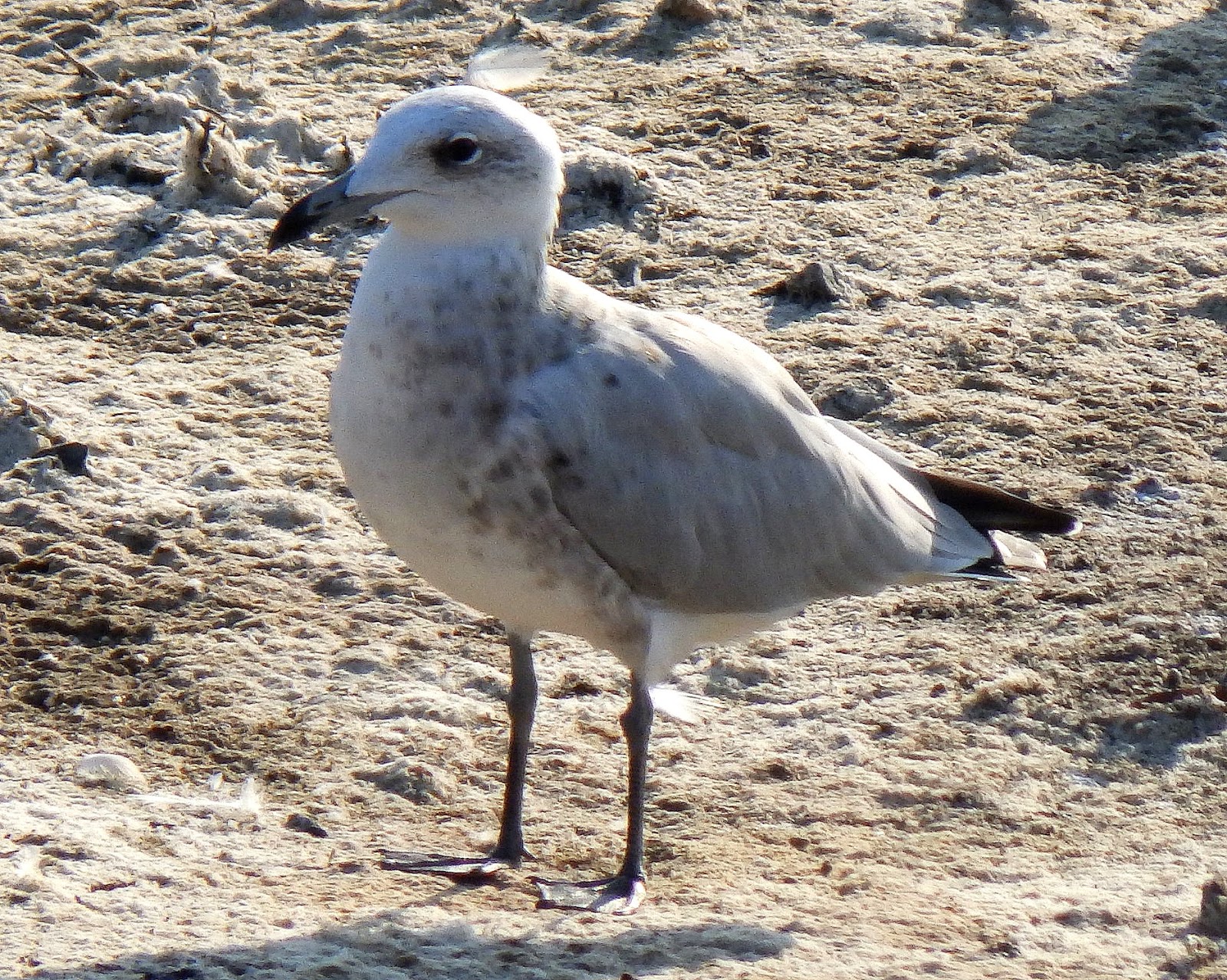 |
| Audouin's Gull, 1st summer plumage |
 |
| Audouin's just moulted to 3rd winter, nice new plumage, identification on bill colour which is still 2nd summer |
20/8/13
17 August : Las Norias & Roquetas
This missive from Dave was awaiting me when I returned from my annual, rain-blessed trip to jolly old England and the Bird Fair, the first drops trickling horizontally across the windows of the 737 as it came in on final approach - typical! Not that I did too much birding although 36 hours on the East Yorkshire coast gave little, with very few terns, no Sanderling at all, only 2 or 3 Oystercatchers and 6 Ringed Plovers, plus a solitary Greenshank winging its way south.
In fact, there were more Peacock butterflies than birds, many in excellent condition, coming in off the sea from a SE direction on both the Wednesday and Thursday and by Saturday there were several around my sister's garden near Leeds. This movement had also been seen by an old friend that I met at the Bird Fair who lives down at Lowestoft (everyone has got to live somewhere).
So, after a long day down at the Bird Fair and spending far too much on a super drawing of White-faced Storm-Petrels by Ian Lewington, looking at trips and destinations and wondering why I couldn't win the lottery, it was back to sunny Spain last evening to be met by a wall of heat which was about double the temperature that I left behind. If the temperatures stay like this there'll be naught from me this week and then I'm off to Madeira and won't be back until 31 August.
So, on to Dave's report ... I see you got really excited, Dave!
Gilly's job as a Care Nurse for Almeria Angels was sending her to Aguadulce, near Roquetas for a 5 hour shift, so I thought I'd chauffeur her down there and check out Las Norias & the Roquetas lake. Mid august is not a good time of the year for birding, especially in the hot afternoon but her shift dictated the timing!
In fact, there were more Peacock butterflies than birds, many in excellent condition, coming in off the sea from a SE direction on both the Wednesday and Thursday and by Saturday there were several around my sister's garden near Leeds. This movement had also been seen by an old friend that I met at the Bird Fair who lives down at Lowestoft (everyone has got to live somewhere).
So, after a long day down at the Bird Fair and spending far too much on a super drawing of White-faced Storm-Petrels by Ian Lewington, looking at trips and destinations and wondering why I couldn't win the lottery, it was back to sunny Spain last evening to be met by a wall of heat which was about double the temperature that I left behind. If the temperatures stay like this there'll be naught from me this week and then I'm off to Madeira and won't be back until 31 August.
So, on to Dave's report ... I see you got really excited, Dave!
Gilly's job as a Care Nurse for Almeria Angels was sending her to Aguadulce, near Roquetas for a 5 hour shift, so I thought I'd chauffeur her down there and check out Las Norias & the Roquetas lake. Mid august is not a good time of the year for birding, especially in the hot afternoon but her shift dictated the timing!
 |
| Squaccco Heron |
I arrived at the
first causeway to discover that the recent water pipe work had
virtually been completed. There was a new fence and much of the
vegetation had been removed giving better views over both sides.....not
that there was much to see! The water level was down and there were new
"No Fishing" signs. To the left I could see numerous pairs of Great
Crested Grebes.....yes, that was it apart from a Yellow-legged Gull. I
fared slightly better on the right hand lake. There were more Great
Crested Grebes and some Little Grebes. Also seen were Coot and
Moorhen....WOW!
I headed round
to the far side, stopping half way along next to the plastic
greenhouses. The pipe work had again removed all the vegetation so one
had great views over this side of the lake. In the shrubs were both
Collared and Turtle Doves. At the end of the spit, which was obscured
by these bushes, were a group of immature Gull-billed Terns together with
some Black-headed Gulls. They revealed themselves when they all took to
the wing. There were a few Barn Swallows and a Little Egret flew
past.
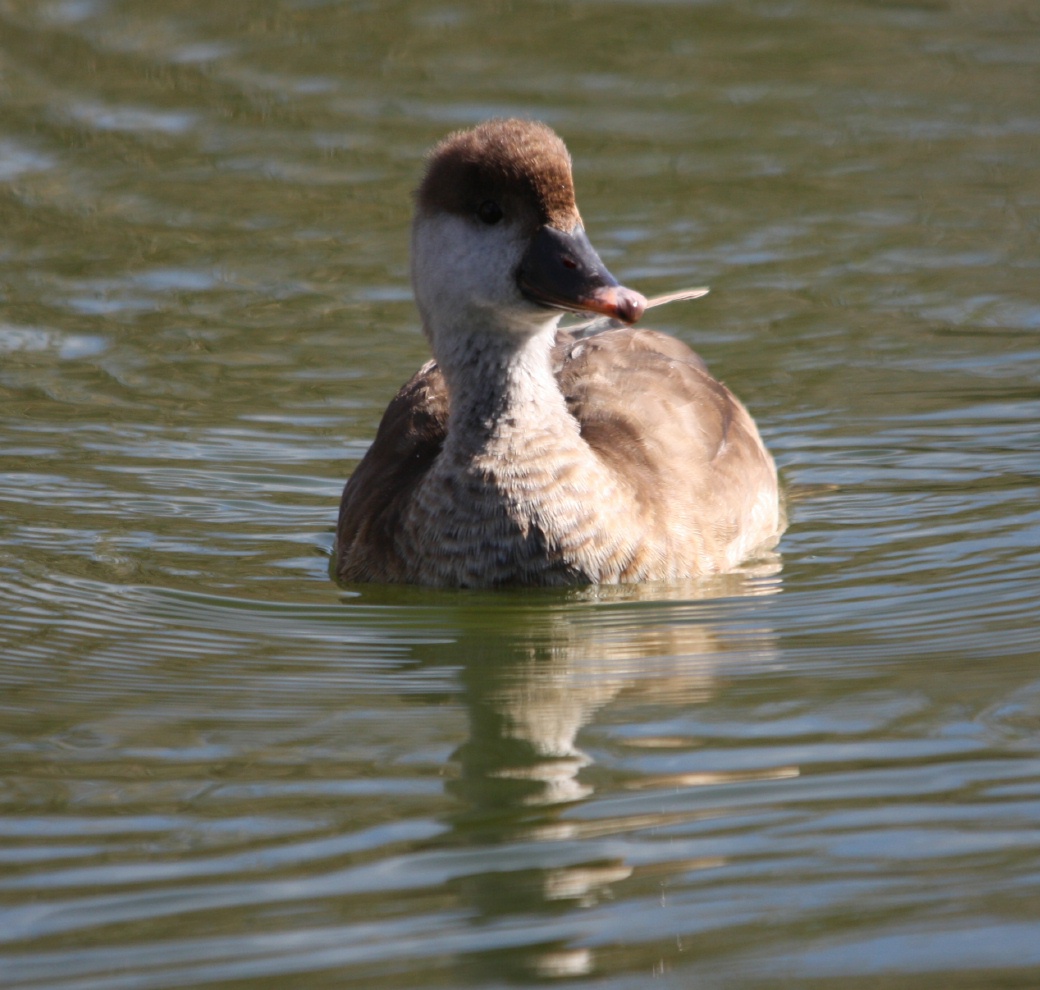 |
| Red-crested Pochard, female |
I then drove to
the second causeway near the plastic recycling factory. There were a few
Cattle and Little Egrets still hanging around the nearly deserted
heronry. I managed to spot a couple of Squacco Herons down by the water's
edge. Also seen was a Kingfisher, a Green Sandpiper and a Grey Heron. I
had seen no wildfowl at all until I spotted a lone Gadwall hiding under
some vegetation. There was a couple of unusual birds flying around the
smaller of the pools. They were medium sized terns with mottled black
markings under wing and body. I could've got some great photos had both
my camera and lens not been returned from the repairers with further
focusing problems (repairers appear to be taking the whole of August
off.....not a happy chappy!). Having looked in Collins the best bet
would be White-winged Black Terns.
I then headed
for Roquetas. On the lake by the hotels I found 68 Greater Flamingos
surrounded by at least a thousand Coots! Also seen were Mallard and a
female Red-crested Pochard. The track up to the Red-knobbed Coot pool
had been graded so up there I drove. Only Common Coots there together
with a female Common Pochard and a Little Grebe with 4 young.
26 species in total. Attached photos from previous visits.
Suscribirse a:
Entradas (Atom)


