This morning, in view of the fact that the water levels at Fuente de Piedra were falling far too rapidly for the liking of myself and the waders, Federico and myself met there at 08.30, himself coming down from Córdoba, the early hour being with the faint hope of missing school parties. Plus we had hoped to contact with the remaining Spotted Redshank in breeding plumage that had been seen at the end of the last week, but t'was not to be.
In fact, it was virtually a waste of time from the wader point of view as the water on both sides of the road in and the walkway had dried up totally, a great shame as it is much used by waders on passage and it drying out so early means that those on late passage to the far north are deprived of a resting and, probably more importantly, a feeding area. It would certainly be extremely useful if some means could be found of keeping a few cms. of water in that area until at least the end of May and then reflooding from late July onwards as migrant waders would then benefit in both directions.
On the left side there 30 Ringed Plovers feeding on something - insects? - and another seen later made the total 31 for the morning, plus a single Common Sandpiper which flushed off a patch of mud about the size of a pocket handkerchief. Going round to the mirador we saw a few more waders, apart from the omnipresent Avocets and Stilts, with a single Redshank and 4 Dunlin - big deal, especially if one counts the pair of Shelduck, the colony of Black-headed Gulls on one artificial island and the other full of Gull-bulled Terns. The lake is full of Greater Flamingos with a notable increase in occupation of the colony nuclei and we scannned and rescanned for any sign of the Lessers but without any joy . However, later in the morning I received a message from Mick Richardson who had been later than us and who did find a pair (thanks, Mick, lucky you).
An immature male Montagu's Harrier showed briefly as did a male Lesser Kestrel, it looks like colonisation of the tower in the field especially for them may bear fruit, if not this year, then in the near future.
A walk around to the laguna at the back gave a Great Reed Warbler (and I insist that they do NOT sing although I'm damned if I know what to call the noises that emanate) and a Melodious Warbler, plus a variety of ducks including 4 pairs of Red-crested Pochard seen and 3 adult Night Herons (I suppose that technically I should call them Black-crowned Night Herons but if you think that you've seen a Yellow-crowned it means you're hallucinating and have been on the happy baccy or worse).
End of visit and we got out just as three coachloads of obnoxious, uncontrolled and very noisy (and possibly noisesome) teenagers were disgorged from three coaches.
By now you will have gathered that I wasn't overly overjoyed with the morning and felt that I could have been doing something more useful - like machine-gunning the youths. Tomorrow morning, to the Guadalhorce. Will it be better, worse or a technical draw?

5/5/14
30 April : Rambla de Almanzora & Vera
I have been away at the Doñana Bird Fair at Isla Mayor, hence the delay. It was hot but very enjoyable, including being recognised by a chap from the UK who remembered my black labrador Samantha from my Filey Brigg days pre 1980, the best birding dog that I have ever come across. Little birding but plenty of White Storks and a lot of Black Kites at Dehesa de Abajo, plus Greenshank, Pratincole and Marsh Sandpiper at El Rocio. So, herewith the Arboleas report. Note that the pohotos are by Gilly!

 After a coffee break in
Villaricos village we headed down to the beach. At first we could only
see a solitary Little Egret on the harbour rocks but eventually Barrie
spotted the head of a Cormorant. We walked over the flat barren area to
the estuary. We heard a Curlew and here we saw more Common Sandpipers and
Ringed Plovers and added Turnstone and Kentish Plover to the wader
list. A Grey Heron posed obligingly. Bee-eaters appeared to be nesting
in the far sandy cliff. Further towards the beach the Eurasian Curlew
was seen as well as Sanderling, Dunlin and a couple of Grey Plovers.
Yellow-legged and Audouin's Gull were also seen. Behind us a
snorkeller armed with a speargun was showing off a metre wide "Manta"
Ray he'd captured. On the rocks we saw solitary Whimbrel, Sandwich Tern
and Whiskered Tern. As we got back to the vehicles a flock of at least
100 Greater Flamingos flew over.
After a coffee break in
Villaricos village we headed down to the beach. At first we could only
see a solitary Little Egret on the harbour rocks but eventually Barrie
spotted the head of a Cormorant. We walked over the flat barren area to
the estuary. We heard a Curlew and here we saw more Common Sandpipers and
Ringed Plovers and added Turnstone and Kentish Plover to the wader
list. A Grey Heron posed obligingly. Bee-eaters appeared to be nesting
in the far sandy cliff. Further towards the beach the Eurasian Curlew
was seen as well as Sanderling, Dunlin and a couple of Grey Plovers.
Yellow-legged and Audouin's Gull were also seen. Behind us a
snorkeller armed with a speargun was showing off a metre wide "Manta"
Ray he'd captured. On the rocks we saw solitary Whimbrel, Sandwich Tern
and Whiskered Tern. As we got back to the vehicles a flock of at least
100 Greater Flamingos flew over.
It was to our local patch
that Gilly and I headed towards on a bright sunny morning. We met up with
ten other members on the embankment above the "old ford", Rambla de
Almanzora. I relayed the sad news that Val Penny-Stewart's mother had
passed away. We send our sincere condolences to Val and Tony. It was
then down to birdwatching.
On the pools near to the opposite bank we
could see Black-winged Stilt, Mallard, Common Sandpiper and Moorhen.
At that point about a hundred sheep surrounded us. The shepherd appeared
to have little control. As the flock eventually made its way down onto
the rambla, their rear ends being snapped at by a sheepdog, Colin
spotted a Glossy Ibis which flew off to the right. Common Swifts were
seen. I then identified a Wood Sandpiper. We began to wander further
towards the defunct desalination plant seeing Ringed Plover as well.
We
saw two more waders with yellow legs. It wasn't until we could see
their size compared to a Ringed Plover that I realised they were
Temminck's Stints. (Alan had seen a pair in the same location a few
months ago). Checking Gilly's photo later with "Collins" at my side it
was a good view of both plumage variations of summer adults. Carrying on
we saw my first Turtle Dove of the year, Little Ringed Plover,
Blackbird, a distant Kevin spotted Kestrel and Greenfinch. I spotted an
iberiae Yellow Wagtail.
After a coffee break in
Villaricos village we headed down to the beach. At first we could only
see a solitary Little Egret on the harbour rocks but eventually Barrie
spotted the head of a Cormorant. We walked over the flat barren area to
the estuary. We heard a Curlew and here we saw more Common Sandpipers and
Ringed Plovers and added Turnstone and Kentish Plover to the wader
list. A Grey Heron posed obligingly. Bee-eaters appeared to be nesting
in the far sandy cliff. Further towards the beach the Eurasian Curlew
was seen as well as Sanderling, Dunlin and a couple of Grey Plovers.
Yellow-legged and Audouin's Gull were also seen. Behind us a
snorkeller armed with a speargun was showing off a metre wide "Manta"
Ray he'd captured. On the rocks we saw solitary Whimbrel, Sandwich Tern
and Whiskered Tern. As we got back to the vehicles a flock of at least
100 Greater Flamingos flew over.
Being about the last to leave, Gilly and I were the only ones to see three Night Herons flying over the rambla by the bridge.
Most of us made our way to the dual carriageway above the lake at
Vera. Here we added Black-headed Gull, Coot and Common Pochard to the
list. Jan spotted a Little Grebe. A pair of White-headed Duck was also
seen as were some more Whiskered Terns. The "resident" Greater Flamingo
was still there. We moved round to the pool opposite the Consum
supermarket. Due to golfing commitments, Les Senior has been failing in
his reed cutting duties. Swipes with a sand wedge needed, Les, to give
better views! Mary and Rod ventured to the pool further along and
added a pair of Shoveler to the list.
Ended up with 45 species. Wader watching at the rambla was great, with great company!
Photos by Gilly.
24/4/14
23 April : Las Norias & Roquetas
Brilliant stuff with the Bittern record, they are very scarce in Andalucía. Mind you, I do have strong doubts about the noises that Great Reed Warblers emit being classed as 'song'.
 The lure of some shopping made
Sandra suggest we visited Las Norias and Roquetas this week and we're
glad that she did! Gilly and I were chauffeured down to the Jct 420
service station by Kevin where we met up with Rod, Linda, Colin, Sandra and John to have a coffee before heading into plastic greenhouse city,
Las Norias. At the first causeway we immediately saw that the water was
as flat as a tack and more disturbingly we had been joined by thousands
of mosquitoes!
The lure of some shopping made
Sandra suggest we visited Las Norias and Roquetas this week and we're
glad that she did! Gilly and I were chauffeured down to the Jct 420
service station by Kevin where we met up with Rod, Linda, Colin, Sandra and John to have a coffee before heading into plastic greenhouse city,
Las Norias. At the first causeway we immediately saw that the water was
as flat as a tack and more disturbingly we had been joined by thousands
of mosquitoes!
There weren't many birds out and about. On the water were Great Crested Grebe, Coot, Moorhen, a Cormorant, Red-crested Pochard and a Little Grebe. We could hear a Great Reed Warbler shouting its song from the far reeds. It eventually showed itself. Round the back of the pump house we managed to see a singing Reed Warbler and a Hoopoe. Gilly spotted a Common Sandpiper. A Little Ringed Plover was also seen as were Yellow-legged and Black-headed Gulls. As we were about to leave two Little Terns flew over.
 It was next to the second
causeway, by the new heronry. Very concerned as there was only one
Little Egret there. I'd have thought there'd be far more activity by
this time of the year. There were numerous Great Reed Warblers singing to
the right. On the left hand lake we saw more Red-crested Pochards and
Great Crested Grebes. Most of the group walked up to the little bridge
whilst Gilly and Linda hung around the vehicles for security. We added
Grey Heron, Common Pochard, Kestrel and Red-rumped Swallow. Gilly and Linda saw a Purple Heron.
It was next to the second
causeway, by the new heronry. Very concerned as there was only one
Little Egret there. I'd have thought there'd be far more activity by
this time of the year. There were numerous Great Reed Warblers singing to
the right. On the left hand lake we saw more Red-crested Pochards and
Great Crested Grebes. Most of the group walked up to the little bridge
whilst Gilly and Linda hung around the vehicles for security. We added
Grey Heron, Common Pochard, Kestrel and Red-rumped Swallow. Gilly and Linda saw a Purple Heron.
 Personally I was slightly
disappointed as we headed towards the lake at Roquetas. After a coffee
stop we arrived by the lake. There were numerous Coot in a flotilla, one
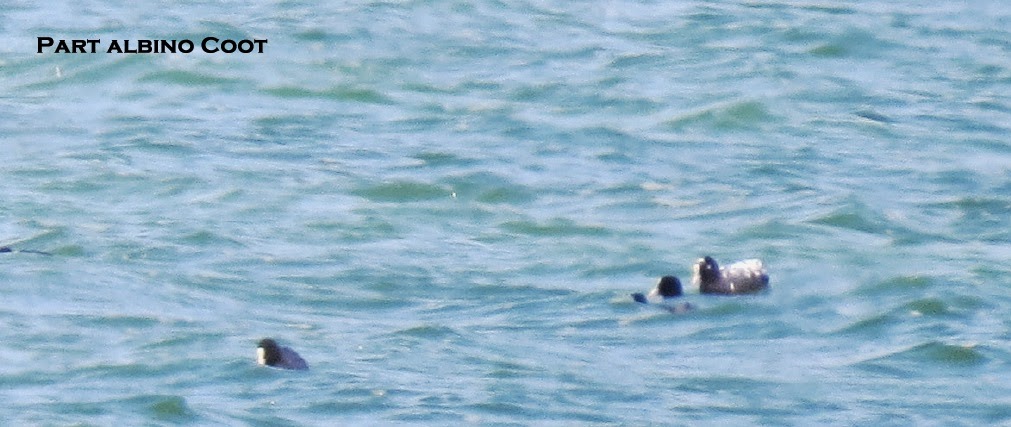
was part albino with a white back. John spotted White-headed Duck.
Colin spotted a bird flying from the reeds on the far side to the reeds
to the right, the town side. It was Night Heron size but brown. Having
seen many juvenile Night Herons I knew it wasn't one of them. Having
checked "Collins" when I got home it was obviously a Bittern. Good spot,
Colin! As we were about to leave some Greater Flamingos were seen
flying.
Personally I was slightly
disappointed as we headed towards the lake at Roquetas. After a coffee
stop we arrived by the lake. There were numerous Coot in a flotilla, one
was part albino with a white back. John spotted White-headed Duck.
Colin spotted a bird flying from the reeds on the far side to the reeds
to the right, the town side. It was Night Heron size but brown. Having
seen many juvenile Night Herons I knew it wasn't one of them. Having
checked "Collins" when I got home it was obviously a Bittern. Good spot,
Colin! As we were about to leave some Greater Flamingos were seen
flying.
The lure of some shopping made
Sandra suggest we visited Las Norias and Roquetas this week and we're
glad that she did! Gilly and I were chauffeured down to the Jct 420
service station by Kevin where we met up with Rod, Linda, Colin, Sandra and John to have a coffee before heading into plastic greenhouse city,
Las Norias. At the first causeway we immediately saw that the water was
as flat as a tack and more disturbingly we had been joined by thousands
of mosquitoes! There weren't many birds out and about. On the water were Great Crested Grebe, Coot, Moorhen, a Cormorant, Red-crested Pochard and a Little Grebe. We could hear a Great Reed Warbler shouting its song from the far reeds. It eventually showed itself. Round the back of the pump house we managed to see a singing Reed Warbler and a Hoopoe. Gilly spotted a Common Sandpiper. A Little Ringed Plover was also seen as were Yellow-legged and Black-headed Gulls. As we were about to leave two Little Terns flew over.
We moved round to the Old
Heronry. A Black-winged Stilt on the point was joined by another (or
one of the previous) Little Terns. We added Gadwall to the list. A large
group of terns then appeared, feeding over the water....Whiskered
Terns. Shortly after 4 Gull-billed Terns flew over. An adult Night Heron
took off from the right and flew up and down the lake.
It was next to the second
causeway, by the new heronry. Very concerned as there was only one
Little Egret there. I'd have thought there'd be far more activity by
this time of the year. There were numerous Great Reed Warblers singing to
the right. On the left hand lake we saw more Red-crested Pochards and
Great Crested Grebes. Most of the group walked up to the little bridge
whilst Gilly and Linda hung around the vehicles for security. We added
Grey Heron, Common Pochard, Kestrel and Red-rumped Swallow. Gilly and Linda saw a Purple Heron. Personally I was slightly
disappointed as we headed towards the lake at Roquetas. After a coffee
stop we arrived by the lake. There were numerous Coot in a flotilla, one
was part albino with a white back. John spotted White-headed Duck.
Colin spotted a bird flying from the reeds on the far side to the reeds
to the right, the town side. It was Night Heron size but brown. Having
seen many juvenile Night Herons I knew it wasn't one of them. Having
checked "Collins" when I got home it was obviously a Bittern. Good spot,
Colin! As we were about to leave some Greater Flamingos were seen
flying.
41 species for the day,
the Bittern being the star bird. Hopefully there will be more activity at
the Las Norias heronry site in the near future.
23/4/14
23 April : Fuente de Piedra & laguna Dulce
This has been Ron's last visit to Fueante de Piedra this winter as he returns to Yorkshire next week and won't be back until next December, so I hoped that we would have some luck, and luck we had in fairly large quantities. We set off earlier, hoping to miss any school trips and failed dismally, but even the noisy teenagers failed to spoil our morning. So, what made the morning so good?
The answer: WADERS IN LARGE NUMBERS, starting off with large numbers of Little Stints, many in superbly pristine breeding plumage but very flighty, as indeed were most of the waders. And how many of these? Well, we estimated at least 100. Not bad for a start.
 But better was to come with an estimated 80+ Curlew Sandpipers, some still in winter plumage but most showing signs of change and at least 2 in full, resplendent breeding plumage.

 These were followed numerically by 60+ Dunlin. Then there were the other lesser numbers of the 12 species of waders seen whichg included 30+ Ringed Plovers, 10+ Redshanks and 4 Common Sandpipers with singles of Ruff, Wood Sandpiper, Turnstone and Greenshank, plus, of course, the ever present and uncounted Black-winged Stilts and Avocets.
 But there was even more to come with the presence of 2 rather distant Lesser Flamingos over to the right from the Information Centre (this rather poor evidential record photo on the left where the colour difference can be appreciated) and a further scan along the lake towards the breeding colony revealed another, even more distant, pair. By chance we ran in to my old friend Manolo Rendón, the director there, and he believes that there might even be a third pair. And to add even more force to the wild birds theory, none of these were ringed.
There were 7 pairs of Red-crested Pochards on the lake behind the Information Centre as well as a few Pochards, Shovelers and a few Mallards, with Avocets apparently sitting fast on the islands, and all to the warbling of a Nightingale..
From there it was off to the laguna Dulce for a last look, stopping at the west end of the Fuente de Piedra laguna to see if we could find the third pair but no luck, although we were treated to a Cuckoo calling but which refused to respond to our calls.
The laguna Dulce is still full of Coots, the predominant species by a great magnitude, god knows where they will all breed, or perhaps they are immatures. Thgere were few pairs of Great Crested and Black-necked Grebes, as well as a few Little Grebes, plus 3 Red-crested Pochards. We saw 4 Marsh Harriers, a male plus 3 immature birds, with a distant female Montagu's Harrier and on the road after leaving had brief views of 2 male Monty's. Of note was the constant, generally northerly, flux of Common Swifts all morning with a few Pallid Swifts, probably about 1% of the total, intermingled.
And thus ended Ron's winter in Málaga and we look forward to next winter, all things being equal.
A note from Mick Richardson of Loja, who yesterday visited the Guadalhorce where he recorded ca.70 Little Terns in front of the reserve and down at Calaburras there was still a single Purple Sandpiper present.
The answer: WADERS IN LARGE NUMBERS, starting off with large numbers of Little Stints, many in superbly pristine breeding plumage but very flighty, as indeed were most of the waders. And how many of these? Well, we estimated at least 100. Not bad for a start.
These were followed numerically by 60+ Dunlin. Then there were the other lesser numbers of the 12 species of waders seen whichg included 30+ Ringed Plovers, 10+ Redshanks and 4 Common Sandpipers with singles of Ruff, Wood Sandpiper, Turnstone and Greenshank, plus, of course, the ever present and uncounted Black-winged Stilts and Avocets.But there was even more to come with the presence of 2 rather distant Lesser Flamingos over to the right from the Information Centre (this rather poor evidential record photo on the left where the colour difference can be appreciated) and a further scan along the lake towards the breeding colony revealed another, even more distant, pair. By chance we ran in to my old friend Manolo Rendón, the director there, and he believes that there might even be a third pair. And to add even more force to the wild birds theory, none of these were ringed.There were 7 pairs of Red-crested Pochards on the lake behind the Information Centre as well as a few Pochards, Shovelers and a few Mallards, with Avocets apparently sitting fast on the islands, and all to the warbling of a Nightingale..
From there it was off to the laguna Dulce for a last look, stopping at the west end of the Fuente de Piedra laguna to see if we could find the third pair but no luck, although we were treated to a Cuckoo calling but which refused to respond to our calls.
The laguna Dulce is still full of Coots, the predominant species by a great magnitude, god knows where they will all breed, or perhaps they are immatures. Thgere were few pairs of Great Crested and Black-necked Grebes, as well as a few Little Grebes, plus 3 Red-crested Pochards. We saw 4 Marsh Harriers, a male plus 3 immature birds, with a distant female Montagu's Harrier and on the road after leaving had brief views of 2 male Monty's. Of note was the constant, generally northerly, flux of Common Swifts all morning with a few Pallid Swifts, probably about 1% of the total, intermingled.
And thus ended Ron's winter in Málaga and we look forward to next winter, all things being equal.
A note from Mick Richardson of Loja, who yesterday visited the Guadalhorce where he recorded ca.70 Little Terns in front of the reserve and down at Calaburras there was still a single Purple Sandpiper present.
18/4/14
17 April : Guadalhorce, two points of view + Doñana Bird Fair update
Yesterday morning I had planned to meet up with Bob and his folks from the Axarquía group and as Ron also wanted to see Bob about something, I took him along with me, after which Ron went his own way upstream whilst I tagged along with Bob's gang and talked more than birded, although we did see some bits and pieces.
A Green Woodpecker had been seen the previous day -a very lost bird indeed! but we didn't see it, which is hardly surprising. There was a brief view fly-by view of a female Little Bittern at the laguna de la Casilla and all the usual ducks, but no Red-crested Pochards today. More unusual was the presence of a very late Snipe skulking on the far side whilst Reed Warblers were chizzing, clicking and churring away and there were snatches of Nightingales in song.

 There was a dearth of waders generally, starting at the wader pool in front of the second hide along the east bank, although an adult Slender-billed Gull, bird of the day for me, flew over. Further down on the río Viejo there were a ones and twos of all three small plovers, plus a single Greenshank fast asleep right down at the far end and a Dunlin, plus 3 Common Sandpipers. Round on the laguna Grande there were 3 more Dunlin, making as grand total of 4! There were good views of 2 Curlew Sandpipers, one of which was showing some signs of breeding plumage. There was still a single immature plumaged Cormorant, the rest having departed for more northerly waters. However, the suprise of the morning was the flyover of 5 Glossy Ibis, a goodly number as we are normally used to seeing one or two only.
 Ron had gone off upstream as his wont and had a far better morning than myself as he walked all the way to the Guadalhorce train station, the one after the airport going towards Málaga. Apart from 8 Nightingales in full cry and 3 Reed Warblers, he turned up 3 Purple Boghens and saw the same 5 Glossy Ibises as they flew down over him towards us down as the Guadalhorce ponds. A pleasant morning.
DOÑANA BIRD FAIR update: The latest information and timetabling for the Bird Fair at Dehesa de Aabajo between 1 and 4 May is available in English at www.donanabirdfair.es. I shall be giving my spiel on pelagic seabirds at 16.00 on 1 May, having the dubious privilege of opening the proceedings. It will be in Spanish but there are pretty pictures!
PS: 18 April - just had the first Woodchat Shrike for this year in the garden! ¡Toma ya! (= beat that)
A Green Woodpecker had been seen the previous day -a very lost bird indeed! but we didn't see it, which is hardly surprising. There was a brief view fly-by view of a female Little Bittern at the laguna de la Casilla and all the usual ducks, but no Red-crested Pochards today. More unusual was the presence of a very late Snipe skulking on the far side whilst Reed Warblers were chizzing, clicking and churring away and there were snatches of Nightingales in song.
There was a dearth of waders generally, starting at the wader pool in front of the second hide along the east bank, although an adult Slender-billed Gull, bird of the day for me, flew over. Further down on the río Viejo there were a ones and twos of all three small plovers, plus a single Greenshank fast asleep right down at the far end and a Dunlin, plus 3 Common Sandpipers. Round on the laguna Grande there were 3 more Dunlin, making as grand total of 4! There were good views of 2 Curlew Sandpipers, one of which was showing some signs of breeding plumage. There was still a single immature plumaged Cormorant, the rest having departed for more northerly waters. However, the suprise of the morning was the flyover of 5 Glossy Ibis, a goodly number as we are normally used to seeing one or two only.DOÑANA BIRD FAIR update: The latest information and timetabling for the Bird Fair at Dehesa de Aabajo between 1 and 4 May is available in English at www.donanabirdfair.es. I shall be giving my spiel on pelagic seabirds at 16.00 on 1 May, having the dubious privilege of opening the proceedings. It will be in Spanish but there are pretty pictures!
PS: 18 April - just had the first Woodchat Shrike for this year in the garden! ¡Toma ya! (= beat that)
16 April: Barca de Vejer - Benalup - N of La Janda
A shortish note on the birding this last Wednesday when I took Ron Appleby up to La Barca de Vejer to tick off Bald Ibis - surely a candidate for one of the most reptilian looking birds, not to mention its hair style which latter greatly amused Ron. We ran into thick fog from Algeciras onwards which extended most of the way up past La Janda but which was quite clear by the time we had parked in La Barca where Stephen Daly was showing the same birds to a small group of clients.
Having walked at least 50m for one of the easiest ticks ever and after Ron had had his fill of this species and counting some 9 nests on the cliff face, we had a coffee. Stephen told me that plans to extend the availability of nest sites by some foreign organisation had been turned down by the administration for some reason which was blamed on cash availability although he intimated that there were some xenophobic tendencies behind it by someone, in spite of the tourist attraction factor being built in alongside the conservation factors for this rare species.
As Stpehen had checked out La Janda the previous day and it was totally dead, we fgollowed his suggestion and went off towards Benalup to watch displaying Montagu's Harriers, 2 males and a female, to the background of a singing Nightingale. At the same point we also saw a pair of Black-shouldered Kites, surely one of the most attractive of raptors but these, like the harriers were rather distant on what was still a rather grey morning.
From there it was on through Benalup and slowly down to the north end of La Janda, stopping along the road before the smelly farm, where we ran in to quite a reasonable selection of raptors with 3 Common Buzzards, a couple of Marsh Harriers, 25 or so Black Kites - some of which were in extremely tatty plumage, and also some Griffon Vultures, one of which was exceedingly dumb and let me more or less walk up to it as it sat in the crown of a wild olive. Here too we saw 4 Booted Eagles and a Kestrel.
Given that La Janda would be a waste of time according the info. from Stephen - and it certainly looked very dry and unsuitable for very much at, we decided to go across to Bolonia and up to the cliff face which we hoped would give us something. There were no Egyptian Vultures to be seen at the usual hole, in spite of prominent 'no climbing' signs but there were Griffon Vultures on the cliff and it may be that their presence has ejected the Egyptian Vultures, a species which is diminishing in numbers generally. On the other hand, below the cliff face a pair of splendid Blue Rock Thrushes were quite prominent whilst a pair of male Lesser Kestrels made an appearance, it being presumed that the females were incubating if the noise levels were anything to go by.
We stopped on the way down and walked the open scrubby area and turned up 4 Woodchat Shrikes and 2 Northern Wheatears.
Not a bad day from my point of view but Ron was very pleased and we did have 9 spp. of raptors, so another happy friend!
 |
| Bald Ibis - last in the beauty contest |
As Stpehen had checked out La Janda the previous day and it was totally dead, we fgollowed his suggestion and went off towards Benalup to watch displaying Montagu's Harriers, 2 males and a female, to the background of a singing Nightingale. At the same point we also saw a pair of Black-shouldered Kites, surely one of the most attractive of raptors but these, like the harriers were rather distant on what was still a rather grey morning.
 |
| mentally retarded Griffon Vulture |
 |
| male Blue Rock Thrush |
Given that La Janda would be a waste of time according the info. from Stephen - and it certainly looked very dry and unsuitable for very much at, we decided to go across to Bolonia and up to the cliff face which we hoped would give us something. There were no Egyptian Vultures to be seen at the usual hole, in spite of prominent 'no climbing' signs but there were Griffon Vultures on the cliff and it may be that their presence has ejected the Egyptian Vultures, a species which is diminishing in numbers generally. On the other hand, below the cliff face a pair of splendid Blue Rock Thrushes were quite prominent whilst a pair of male Lesser Kestrels made an appearance, it being presumed that the females were incubating if the noise levels were anything to go by.
We stopped on the way down and walked the open scrubby area and turned up 4 Woodchat Shrikes and 2 Northern Wheatears.
Not a bad day from my point of view but Ron was very pleased and we did have 9 spp. of raptors, so another happy friend!
 |
| Lesser Kestrel male |
17/4/14
16 April : Sierra de María
I've got an entry iof my own from yesterday top do and put in but that will be online tomorrow. Therefore, herewith the Arboleas Group's entry with a a photo of the very generous donation of the bird identification posters the La Piza restaurant.
At Alan's request as he's heading back to the UK till September, we're going to one of my favourite locations, the Sierra de Maria. Gilly and I picked up Kevin and headed for Maria seeing only a few birds on the way to the Garage cafe at the far end of the town. There we met up with 12 other members for a coffee and chat before making our way to the Chapel. Colin spotted a Black Redstart as we left.
 On the drive up we saw
Goldfinch, Chaffinch, Serin and Great Tit. I spotted a departing pair
of Rock Sparrows as we pulled into the chapel car park. Someone spotted
"big birds" over the ridge to the right. There were about twenty odd
Griffon Vultures soaring on a thermal. Checking the mountain ridge above
us we could see another 9 perched up there. Alan then spotted an eagle
gliding left to right along the ridge....an adult Golden Eagle. We then
wandered over towards the water trough, hearing a Nightingale as we
approached, but never saw or heard it again. Things didn't look good at
the trough as two cats were hanging around, but they soon departed. A
warbler was seen in the small trees. I thought it might be a Willow and
Alan thought a Bonelli's and he was proved right. Birds then started to
come to the trough to drink. We had both Cirl and Rock Buntings. A
wonderful male Pied Flycatcher was hunting from the poplar tree.
On the drive up we saw
Goldfinch, Chaffinch, Serin and Great Tit. I spotted a departing pair
of Rock Sparrows as we pulled into the chapel car park. Someone spotted
"big birds" over the ridge to the right. There were about twenty odd
Griffon Vultures soaring on a thermal. Checking the mountain ridge above
us we could see another 9 perched up there. Alan then spotted an eagle
gliding left to right along the ridge....an adult Golden Eagle. We then
wandered over towards the water trough, hearing a Nightingale as we
approached, but never saw or heard it again. Things didn't look good at
the trough as two cats were hanging around, but they soon departed. A
warbler was seen in the small trees. I thought it might be a Willow and
Alan thought a Bonelli's and he was proved right. Birds then started to
come to the trough to drink. We had both Cirl and Rock Buntings. A
wonderful male Pied Flycatcher was hunting from the poplar tree.
 We carried on up towards
the botanical gardens, seeing nothing new. A Crossbill was perched atop
one of the pines. Alan identified a singing Woodlark. Walking round the
medium walk we had good views of Short-toed Treecreeper and Firecrest.
Not so good views of Subalpine and Bonelli's Warblers.
They definitely hadn't arrived in numbers and there was no sign yet of
Orphean or Melodious Warblers. Brian meanwhile had spotted a Raven and
the Golden Eagle had returned, circling high above us. Also seen were
Jay, Woodpigeon, Long-tailed and Coal Tits. John thought he heard a
distant Great Spotted Cuckoo. Heading back down towards the vehicles
Gilly spotted a Sparrowhawk near the trough.
We carried on up towards
the botanical gardens, seeing nothing new. A Crossbill was perched atop
one of the pines. Alan identified a singing Woodlark. Walking round the
medium walk we had good views of Short-toed Treecreeper and Firecrest.
Not so good views of Subalpine and Bonelli's Warblers.
They definitely hadn't arrived in numbers and there was no sign yet of
Orphean or Melodious Warblers. Brian meanwhile had spotted a Raven and
the Golden Eagle had returned, circling high above us. Also seen were
Jay, Woodpigeon, Long-tailed and Coal Tits. John thought he heard a
distant Great Spotted Cuckoo. Heading back down towards the vehicles
Gilly spotted a Sparrowhawk near the trough.
At Alan's request as he's heading back to the UK till September, we're going to one of my favourite locations, the Sierra de Maria. Gilly and I picked up Kevin and headed for Maria seeing only a few birds on the way to the Garage cafe at the far end of the town. There we met up with 12 other members for a coffee and chat before making our way to the Chapel. Colin spotted a Black Redstart as we left.
On the drive up we saw
Goldfinch, Chaffinch, Serin and Great Tit. I spotted a departing pair
of Rock Sparrows as we pulled into the chapel car park. Someone spotted
"big birds" over the ridge to the right. There were about twenty odd
Griffon Vultures soaring on a thermal. Checking the mountain ridge above
us we could see another 9 perched up there. Alan then spotted an eagle
gliding left to right along the ridge....an adult Golden Eagle. We then
wandered over towards the water trough, hearing a Nightingale as we
approached, but never saw or heard it again. Things didn't look good at
the trough as two cats were hanging around, but they soon departed. A
warbler was seen in the small trees. I thought it might be a Willow and
Alan thought a Bonelli's and he was proved right. Birds then started to
come to the trough to drink. We had both Cirl and Rock Buntings. A
wonderful male Pied Flycatcher was hunting from the poplar tree. We carried on up towards
the botanical gardens, seeing nothing new. A Crossbill was perched atop
one of the pines. Alan identified a singing Woodlark. Walking round the
medium walk we had good views of Short-toed Treecreeper and Firecrest.
Not so good views of Subalpine and Bonelli's Warblers.
They definitely hadn't arrived in numbers and there was no sign yet of
Orphean or Melodious Warblers. Brian meanwhile had spotted a Raven and
the Golden Eagle had returned, circling high above us. Also seen were
Jay, Woodpigeon, Long-tailed and Coal Tits. John thought he heard a
distant Great Spotted Cuckoo. Heading back down towards the vehicles
Gilly spotted a Sparrowhawk near the trough.
We then convoyed down
towards the plain stopping at the ruined farm buildings. None of the
usual Crossbills waiting to drink, only Chaffinch and Serin. A Carrion
Crow was seen and a pair of Hoopoes.
 |
| poster presentation, Dave in centre |
Moving on to the farm trough
area we only added Linnet to the list. On the plain, birds were few and
far between. Crested Lark, then a Short-toed Lark. At the ruined
buildings near the end were a pair of Wheatears. I thought they were
Black-eared but looking at the photos proved them to be ...
apologies Alan and John! A Hoopoe also appeared. At the hamlet there
were about 6 Lesser Kestrels seen as well as another Northern Wheatear.
It was then back to La
Piza for lunch, watching feeding Hawfinch above us and Crossbill, Great,
Crested and Blue Tits using the feeding station. Whilst in Extremadura
Gilly and I picked up a couple of bird posters, one on Spanish
raptors, the other on woodland birds. We framed them and donated them to
the cafe for display. It was very much appreciated.
A great days birding I'm sure everyone would agree. 44 species in the end.
Suscribirse a:
Entradas (Atom)


