28/1/16

27 January : Adrian's patch (Puerto Lumbreras - Vélez Rubio)

male Black Redstart

I too was out yesterday to La Janda, but first herewith Dave's account of the Arboleas' Group visit to Adrian's patch. My account will follow tomorrow or Saturday. As a fervent patcher myself (as opposed to being a lister/twitcher), I found this very interesting. Mind you, it does help to have a varied, habitat. I shall put in the Spanish names later as I'm a bit short of time today.

If you've read previous reports, Adrian lives in the foothills between Puerto Lumbreras and Velez Rubio. Today he kindly agreed to show group members round his patch. The members included Colin, Sandra, Rod, Linda, Paul, Kath, Jacky and Steve. We all met up at the cafe off junction 6 on the A91 Granada motorway. After a coffee we headed off in three cars, guided by Adrian, along country lanes and tracks with overcast skies above us. It's always difficult birding in a convoy as the following vehicle passengers don't often see what the leading vehicle occupants do. We started with Jackdaws in the car-park and along the way we added Goldfinch, Chaffinch, Black Redstart and Stonechat. I missed the Green Woodpecker. A lark perched upon a ruined hut we believe was a Thekla. We saw a Mistle Thrush before we got to a large farm compound surrounded by a chain-link fence. Perched upon it was a Stonechat, which was briefly joined by a Dartford Warbler and a Blackcap. Colin in their car spotted a Sardinian Warbler.
Crag Martin
We made our way towards the Embalse de Puentes, seeing a Cormorant on the way. From up on the dam many of his mates were resting on rocky outcrops, on a distant concrete bank and feeding on the water. Above us were hundreds of Crag Martins, a pair of which came to perch on a gutter pipe near us. Paul spotted a House Martin. On the water we saw two Yellow-legged Gulls and eventually we had a Little Grebe and Jacky spotted a Coot. Little birds only included White Wagtail and Chiffchaff. The water level was ok, but the distant reed beds and shrubs all appeared to be dead. We drove down to the pine tree wood below the dam to have our picnic lunch. Colin spotted a Grey Heron and Paul was first to see a Robin. Jacky saw a Grey Wagtail  and a pair of Mallard was also observed. Apart from those we saw Serin and I heard Rock Sparrows calling.
male Blue Rock Thrush
From there we made our way to La Parroquia village, seeing a Black Wheatear on the way. At the far end of the village is a rambla with a stream. The recent storms had caused flood damage so there was little vegetation. A pair of Grey Wagtails and Chiffchaffs were seen while a Kestrel was eyeing us up from the power line. Paul was first to spot at least 3 distant Griffon Vultures. Steve saw a Moorhen.
Moving on we saw some Red-legged Partridge and Hoopoe. Our ultimate stop was at some abandoned farm buildings. (On previous visits we'd stopped there first) The sun was now shining which showed off the colour of the male Blue Rock Thrush very well. A male Black Redstart also showed well as did a male Blackcap.
We ended up with 37 species. The scenery and almond blossom was fantastic. Thank you again to Adrian for showing us round.

25/1/16

20 January: Las Norias & Roquetas

Sorry for the delay in getting this out, Dave and readers. Life is complex. One day it won't be and I'll die of fright/shock/bordeom! On the birding front, news of a male Redstart (Colirrojo real) seen on La Janda late last week, plus Barn Swallows (golondrina común) and other hirundines! Even better/worse (it'll be worse if the weather goes sour), records also of Pallid Swifts (vencejo pálido) and at least one Common Swift (vencejo común) seen over to the west also.

Gilly was busy so I was on my own picking up Paul from Los Gallardos this morning. We were heading for Las Norias the far side of Roquetas. It was grey skies and drizzle to heavy showers as we drove down the A7/E15 motorway. We met up with Alan and Richard at the junction 420 service station and then made our way the the first causeway at Las Norias. Thankfully the weather had improved with only a few droplets falling. We were met by numerous Crag Martins (avión roquero) flying around. On the water there were loads Shovelers (pato cuchara) together with all the common grebes. 
I spotted a distant group of wildfowl which included both Red-crested (pato colorado) and Common Pochard (porrón común) and White-headed Ducks (malvasía cabeciblanca). Then a great surprise...a House Martin (avión común)! A Night Heron (martinete) flew over along with Black-headed (gaviota reidora) and Yellow-legged Gulls (gaviota patiamarilla). Alan spotted a distant group of Teal (cerceta común). The bushes were alive with Chiffchaffs (mosquiteros comunes).
We moved to the next observation point. Alan saw a Zitting Cisticola (buitrón) as we parked up. Off the rocky point there were more Red-crested Pochard and some Gadwall (anade friso) as well some Teal (cerceta común). A small flock of Dunlin (correlimos común) and Little Stint (correlimos menudo) flew past and landed, as did a Meadow Pipit (bisbita pratense) arrived there.
1stW Slender-billed Gull
We drove round to the second causeway where there more Meadow Pipits (bisibita pratense) and  Alan spotted a Chaffinch (pinzón común) and also Crested Lark (cogujada común) and Black Redstart (colirrojo tizón). Paul spotted a couple of roosting Night Herons (martinetes) on the far bank. As we walked up towards the small bridge a Cattle Egret (garcilla bueyera) flew over, but was immediately overshadowed by a flight of 18 Night Herons (martinetes) flying in to the reed beds. Another (or the same) House Martin (avión común) was seen. And the sun was shining!
We headed towards Roquetas, adding a couple of Hoopoes (abubillas) on the way. After a coffee stop we drove towards the reed beds and lake. As I was driving, I missed the Marsh Harrier (aguilucho lagunero) immediately to our right, but once stopped over the other side near the hotels we saw two individuals. The lake contained at least 500 Lesser Black-backed Gulls (gaviota sombría) and a similar number of Black-headed Gulls (gaviota reidora) and of Coots (focha común) in two huge rafts. Twenty odd Black-necked Grebes (zampullín cuellinegro)were synchronised diving. 
Spotted Redshanks
As there were only four of us, we all got in my 4x4 and made our bumpy way to the Salinas de Cerrillos, some 4 kilometres further into the reserve. Usually a wader hotspot, unfortunately the water level was high. On the only sandy island above the water level sat two adult Yellow-legged Gulls (gaviota patiamarilla), a couple of Cormorants (cormorán grande) and a 1st winter Slender-billed Gull (gaviota picofina) with two or three Black-necked Grebes (zampullín cuellinegro) on the pool to our left. A Dartford Warbler (curruca rabilarga) showed well on the shrubs and many Chiffchaffs (mosquiteros comunes). Richard won first prize for best spot and bird of the day with a Great White Egret (garceta grande) over to the right. I spotted the 20 odd Spoonbills (espátulas) on the causeway and on our way back we added Audouin's Gull (gaviota de Audouin). We found a pair of Spotted Redshank (archibebe oscuro) feeding next to a normal Redshank (archibebe común) so it was good to see the comparison between the two species. We stopped off at the "Red Knobbed Coot" pool. They seem to be no more, although we did see the more common ducks, including White-headed (malvasía cabeciblanca).
A good day's birding. 50 species seen and the weather god was with us!

14/1/16

14 January : Sierra María

The second offering from Dave in two days. Leaving aside any other comments about spp., a Striped Crake (polluela culirroja) was found wandering around a village in Córdoba on Tuesday, taken into care and released at a suitable site on Wednesday. This is a rare subSaharan species and there are only three good European records, the first also being in Spain. Like the Allen's Gallinule (calamoncillo africano) of which most European records occur during the winter months, it is forced to move by drought situations. A French birding friend saw one from his office window one snowy January morning when he was based in Vendée!
By the way, the Striped Crake appears to have fled as it was not seen today, Thursday.

With Paul Groves and daughter Sara​ being over on their hols, it gave me an opportunity to have another days birding. Today was Sara's ??th birthday and Paul asked if we could go to the Sierra de Maria as a treat. Well wrapped up against the cold I took them up there. We met up with Brian and Mary at the Repsol Garage cafe. Brian suggested we did the plain first to give the shaded Botanical Gardens a chance to warm up a bit! We first stopped at the farm buildings. 
I immediately spotted a Rock Sparrow (gorrión moruno) on a roof ridge. Some Carrion Crows (corneja) were seen before Sara spotted a Green Woodpecker (pito real) feeding under the pine trees. Obviously it was an Iberian race. Are they separated now from the rest of the Green Woodpeckers in Europe? (Don't know; Andy) We also saw a Jay (arrendajo), some Mistle Thrushes (zorzal charlo) and a Blackbird (mirlo). I spotted a male Cirl Bunting (escribano soteño) atop a tree. He was joined by numerous Crossbills (piquituertos) and some Chaffinches (pinzones comunes). Paul spotted a Robin (petirrojo) and we heard a Great Spotted Woodpecker (pico picapinos) drumming.
We made our way to the farmyard trough where, in the surrounding trees, we saw reasonable numbers of Linnet (pardillo), Rock Sparrow (gorrión chillón) and Corn Buntings (trigueros). Brian spotted a pair of Hoopoes (abubillas) and Goldfinch (jilguero) and Crested Lark (cogujada comun) were also observed. 
We convoyed slowly down the straight plain road. We struggled to see any birds till I spotted a Calandra Lark (calandría)perched on a rock. A bit further down we found a pair of Little Owls (mochuelo)on a pile of rocks. We stopped at the hamlet. We heard a strange bird call coming from the rough field on the opposite side of the road. I checked out the call of a Black-bellied Sandgrouse (ganga ortega) on my phone and we were pretty certain that was the culprit. We search for ages with a negative result. We did see an extraordinary flock of 30+ White Wagtails (lavanderas blancas). 
We headed for the Botanical Gardens. The wind had got up and it had clouded over. We only saw a Great Tit (carbonero común) and Chaffinch (pinzón común) by the chapel and nothing by the water trough. On the ploughed fields we did see a single Rock Bunting (escribano montesino). In the garden Mary identified the call of Crested Tits (herrerillo capuchino). These were joined by Short-toed Treecreepers (agateador común) and Long-tailed Tits (mito). We decided that due to the weather we'd adjourn to the La Piza forest cafe for an early lunch. We were met by a chorus of Crossbill (piquituerto) calls from the tree tops.
As we'd not seen a raptor all day we diverted to the Velez Blanco Vulture Feeding Centre on the way home. The enclosure was empty but we did see up to 18 Griffon Vultures (buitre leonado) soaring above the "Grandmother's molar" mountain to conclude a reasonably successful days birding.
If you include the two "heard" observations, we ended up with a total of 30 species for the day.

13 January : Cabo de Gata & Rambla Morales

So, there I was yesterday afternoon, seated on the terrace with the last daylight over the sea still sufficient to see what was moving when past me shot my first Barn Swallow of the year. A nice end to a day which had hardly been brilliant. So when I opened my mail this morning there was Dave's report on the trip to Cabo de Gata and Rambla Morales which he described below. First, take the canine terrorist for a walk as one does otherwise an always precarious peace is totally impossible. 
Coming through the centre of Torremolinos I heard a thin tseep type call from a large ficus. I am not good on warbler calls but this I didn't know so there was I, standing looking up into the ficus while this bird continued calling and passersby wondered if I'd flipped my lid whilst Whisky tried to attack any other passing canine. Eventually view one when the said warbler, a tiny little soul, came down from the heights and showed a good strong wing bar. Heart leaps. When the second view showed a nice bright supercilium the heart even went pitter-patter-pit and when the third view gave both the large wing bar, the supercilium and a second small and ill-defined wingbar, that clinched it - a Yellow-browed Warbler - and only 5 minutes from home. By the by, these are no longer classed as rarities as of 1 January this year.
The rest of the day went by and it is now evening and I am now going to put together Dave's report and then add a second that he has sent which will be in front of this. Sorry, Dave, but that's the way it goes.
 
Before I start on today's report (i.e.: Wednesday's), Colin and Sandra were at Cabo de Gata, near the first hide, yesterday and they saw a Short-toed Eagle (aguila culebrera). Wonder if we can beat that! We met up with Colin, Sandra, Rod, John, Alan and visiting birders, Paul and daughter Sara. After a coffee in Pujaire we made our way to the first hide. Apart from numerous Greater Flamingos (flamencos)we also had a few Slender-billed Gulls (gaviota picofina), Mallard (azulón) and Shelduck (tarro blanco). There was a wide variety of waders but not in large numbers. We saw Redshank (archibebe común), a probable Spotted Redshank (archibebe oscuro), Greenshank (archibebe claro), Whimbrel (zarapito trinador), Eurasian Curlew (zarapito real), Grey Plover (chorlito gris), Bar-tailed Godwit (aguja colipinta), Ringed Plover (chorlitejo grande) and Avocet (avoceta). I beat John to finding a group of about 12 Spoonbills (espátula), but he "trumped" me shortly afterwards by noticing just to the left of the distant Spoonbills were three Common Cranes (grullas)! 
Stone Curlew
Also seen were Little Egret (garceta común), Cormorant (cormorán grande), Kestrel (cernicalo vulgar), Iberian Grey Shrike (alcaudón real) and the first of many Stonechats (tarabilla común). Sandra spotted a Crested Lark (cogujada común) on the stone wall. 
We made our way to the beach for a quick seawatch. Only saw another Cormorant (cormorán grande), but did have Crag Martin (avión roquero) over the savannah. At the second hide we saw a couple of Stone Curlews (alcaraván) and a pair of Golden Plovers (chorlito dorado). A rare find was a Wigeon (anade silbón). A Lesser Black-backed Gull flew over. Gilly managed to count 625 Greater Flamingos (flamencos).
At the public hide we saw both Sardinian (curruca cabecinegra) and Dartford Warblers (curruca rabilarga). Only one Black-necked Grebe (zampullín cuellinegro) was visible. Waders added to the list included Common Sandpiper (andarríos chico), Black-winged Stilt (cigüeñuela), Dunlin (correlimos común), Kentish Plover (chorlitejo patinegro),  Little Stint (correlimos menudo) and Sanderling (correlimos tridáctilo). Also seen were a female Blackcap (curruca capirotada) and Meadow Pipit (bisbita pratense). A small number of Golden Plovers (chorlitos dorados) were seen on the scrubland. As we had a cuppa by Cabo de Gata beach a small flock of Turnstones (vuelvepiedra) flew by.
Golden Plover
I led the convoy along the beach track to the Rambla de Morales. A small flock of Lesser Short-toed Larks (terrera marismeña) flew across our path. The Rambla itself was quite disappointing. We added Little Grebe (zampullín chico), Coot (focha común), Moorhen (gallineta de agua) and a number of Shoveler (pato cuchara) to the list. A Chiffchaff (mosquitero común) was seen. Yes, just the one! A Cattle Egret (garcilla bueyera) flew over. Gilly and I saw another Meadow Pipit (bisbita pratense) as we made our way our via the campsite. John and Alan spotted a flock of smaller birds on the savannah on their journey out. Mostly Skylarks (alondra común), but also a few Corn Buntings (trigueros). Gilly and I stopped at Los Gallardos on the way home to see Val and Rob. I may have been mistaken, or was it an imitating Starling, but I'm certain I heard the first few chords of a Great Spotted Cuckoo (críalo)! The list total for Cabo and Morales was 54, even though we dipped out on White-headed Duck, Zitting Cisticola and Cetti's Warbler!


​Golden Plover

12/1/16

6 January : Rambla de Almanzora & Vera

Happy Birding New Year!! 
(is there any other sort?)
adult Audouin's Gull
As it was Three Kings Day (Los Reyes Magos), the Spanish version of Christmas Day, we hadn't arranged an official group day out, but when Alan and John began to mention they'd like to go somewhere, we decided to brave the high winds and hit the Rambla de Almanzora. Before meeting at the "ford", Gilly and I checked out the pools on the far side of the rambla. We only saw Moorhen, Mallard and Black Redstart, but Alan and John following suit some minutes after us also had Snipe and Meadow Pipit. As we walked up the path above the rambla, the birds were obviously sheltering from the cold north easterly winds. We managed to see Stonechat, Chiffchaff, Serin and Spotless Starling. As we reached the sewage works, Alan spotted a Common Sandpiper on the edge of one of the pools and a Green Sandpiper was flushed from a pool below us. A Black-winged Stilt was also seen and a Grey Wagtail was beside the large pool. We added Robin, Greenfinch, Magpie and Cetti's Warbler as we headed back. A check of the ford pool only revealed numerous Mallard and Moorhen. Gilly flushed a Snipe. 
adult winter Mediterranean and Black-headed Gulls
Apart from the usual crow scarers banging off, one of the local farmers was using a tape loop of birds in distress. Sounded like a cross between a Curlew and Gull being strangled. Just what you want to hear whilst birding!
After a refreshing cuppa in Villaricos village, we made our way to the beach. On the rocks outside the harbour were Black-headed, Audouin's and Yellow-legged Gulls. John spotted a Grey Heron hiding behind a steel pole. There were a couple of Cormorants and a pair of Sandwich Terns. On a closer rock I spotted a Turnstone. I also saw an immature Gannet out to sea. 
Grey Plover
We made our way to the estuary. Over 60 Crag Martins were flying around. Apart from the usual Coot, Cormorant and Black-headed Gulls there were also Audouin's Gulls, Grey Heron and a pair of Shovelers which John spotted. Out nearer the beach there were a couple of immature Greater Flamingos and numerous little waders. Little Stint, Dunlin, Sanderling, Kentish and a single Little Ringed Plover. Also seen was a Little Egret and a few Mediterranean Gulls. Walking back along the beach we saw more Dunlin and Sanderling plus a Grey Plover.
We did a quick check at the Consum dual carriageway in Vera Playa. There was mostly wildfowl there. Small groups of Teal and Gadwall, but hundreds of Shovelers. 
From there we went to the "Millionaires" pool. Head towards the Buganvillas roundabout and turn left just before you get there. Follow the road down towards the beach and the pool is on your left. We had very good views of Mediterranean and Black-headed Gulls plus a very obliging Sanderling posing nearby. We added Little Grebe to the list.
Here we separated. Gilly and I went for lunch whilst Alan and John stopped off at the Rio Agua at Mojacar on their way home. They were rewarded with views of a Purple Swamphen and chicks!
Including the latter, we clocked up 46 species. Not bad considering the wind!

31/12/15

30 December : El Fondo /El Hondo

Reed Bunting
A few weeks ago Helen Commandeur e-mailed us, inviting Gilly and I to visit her patch. El Fondo, which is near Elche, is about 40 minutes from her house. El Fondo is a very large bird reserve, but it has limited access. Helen says that the North Gate entrance is only open now on a Saturday morning. The water level in that area is apparently very low. 
I asked John and Alan to join us. Us lot met up at the Cox Service Station before heading to the reserves Information Centre to meet up with Helen. Have got to say what a transformation has taken place since our last visit. Alan had never been here before. 
The Information building is now surrounded on three sides by shallow water with small reed beds and shrubs, instead of unfriendly low lying scrubland. We'd already logged many of the commoner usual suspects before we saw our first Marsh Harrier. It's fair to say that during our visit we must have clocked up 30-40 sightings. Chiffchaffs were in abundance. We saw a few Robins and numerous Stonechats. At the small pool adjacent to the centre I spotted a Purple Swamphen. The sun was directly in our eyes so observing it was hard. Very luckily another one was seen behind us, showing very well and giving Gilly plenty of photo opportunities. Also seen in that area were Coot, Moorhen, Little Grebe and Little Egret. A flight of Greater Flamingos was seen in the distance. 
Kingfisher
We moved along the raised boardwalk to the observation platform. Alan spotted a Bluethroat and Helen saw our first Kingfisher. Some Reed Buntings were seen feeding. We saw more Kingfishers, one of which posed delightfully (Sorry, Val!). Moving on to the first hide, John thought he saw a female Hen Harrier. Here we added Cetti's Warbler, Common Pochard and Black-necked Grebe. The next hide gave us Greater Flamingos and numerous Shelducks. A Bluethroat displayed well right in front of us, but I only managed to get a rear view! 
A flight of Glossy Ibis was seen. Heading back to the vehicles a squadron of 16 Stone Curlews flew round us. We were then taken to a raised platform on the south western side of the reserve. From this elevated position we had great views over most of the reserve. We could see the line of mature eucalyptus trees lining the track from the North Gate some two kilometres away. 
flight of Glossy Ibis
Alan spotted it first....a very large dark/black coloured  eagle perched on top of one of these trees. It had to be one of the three Spotted Eagles wintering on the reserve. Couldn't tell from that distance whether is was "Tonn" , "Not Tonn" or "The other one". Tonn is a satellite tagged eagle from Estonia ('Tonn' was seen on 23/12, satellite transmitter not working now: from rarebirdspain - Andy). We also saw Booted Eagle, a flock of about 60 Lapwings (desperately searched for the reported Sociable Lapwing without success!) and Cattle Egret. Smaller birds seen included Jackdaw, Greenfinch, Serin and Iberian Grey Shrike (or is still Southern Grey Shrike?). 
leucistic Black-necked Grebe
After a hearty lunch we made or way to the southern end of the reserve. We luckily came across a field with 20 odd Glossy Ibis  feeding therein and in another field a flock of 20 Common Cranes. Also seen were Linnet and Goldfinch. At the final hide which gave great views over a large expanse of water we added Red-crested Pochard amongst a huge number of Common ones. One pair of Shoveler and John had a Teal. Also of interest was a part albino (= leucistic) Black-necked Grebe.
What a great day. Thank you so much, Helen. We saw 49 species in all. No gulls and only Green Sandpiper in the wader department if you exclude Lapwing and Stone Curlew! We also missed an Osprey which flew over the Information Centre as we were leaving!

26/12/15

25 December : La Janda


What better way to spend Christmas morning and the first part of the afternoon than birding? Leaving the madding crowds  and the knowledge that my daughter was going to feed me later. And she’d even offered with the bait of sticky toffee pudding. Not quite up to the Cartmel standard but damned good. So, as I’d awoken early (06.10) I was on the way and down at Tarifa by 08.30, having been delayed whilst emergency services dealt with some clown who’d crashed his/her car all on his/her own some 5 kms outside Tarifa. The car will never be the same again as the firemen were cutting off its roof and very probably the driver and any passengers won’t be the same either .
The birding was good too, with one of the first birds seen being a Long-legged Buzzard (busardo moro) type. In fact, there were good numbers of Common Buzzard (busardo común) with at least 10 seen during the morning. That said, apart from a similar number of Marsh Harriers (aguilucho lagunero), there was rather a dearth of raptors with only a few Kestrels  (cernicalo vulgar).
Spanish Sparrows
The track alongside the drainage canal was quite productive, the first rice fields having been drained and the ditch slightly muddy and into which my little monster paddled. There were a few Lapwings (avefrías) in these fields and a variety of finches, mostly Greenfinches (verderones),  Goldfinches (jilgueros) and House Sparrows (gorriones comunes). Theare were quite a few Linnets (pardillos) and overhead there were both Skylarks (alondra común) and Calandra Larks (calandrías), plus the welcome and rather surprising presence of a small flock of Spanish Sparrows (gorrión moruno), a species that I have ever seen only once before on La Janda.
Purple Boghens
Further along on the left side (moving N) there were still plenty of flooded paddies, although it appeared that they had been ploughed and possibly roughly harrowed, but there was a nice area of wáter. Apart from two flocks of Spoonbills (espátulas) numbering some 58 birds, 4 of which at least were carrying colour rings but too distant too read, I also counted 3 Green  Sandpipers (andarríos grandes) and 5 Greenshanks (archibebe claro). All this was quite modest stuff, nice and with decent views whilst on the east side of the drainage canal some 800 Cranes (grullas) fed peacefully with that lovely sound that they make whilst at rest.
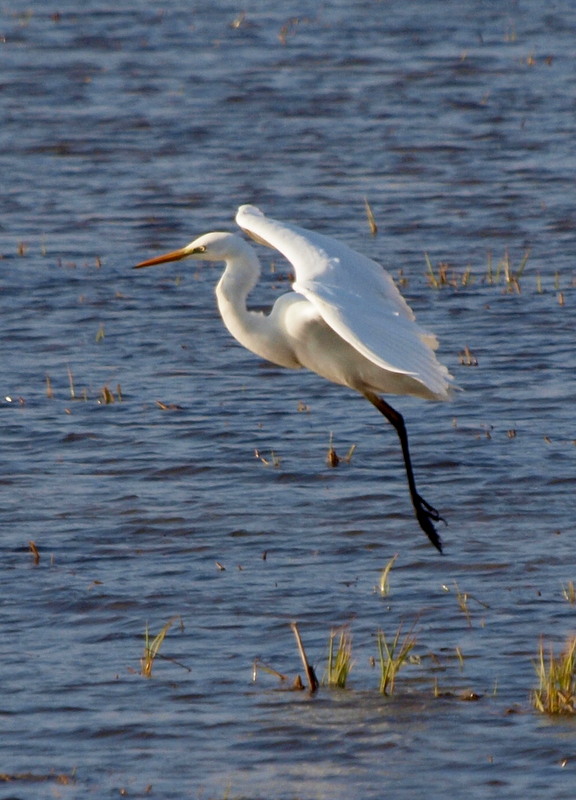
Great White Egret/Heron
However, the birding level took a sudden upturn when 4 ducks flighted in and settled . A quick ‘scoping revealed them to be Marbled Teal/Duck (cerceta pardilla) (take your pick on the English name). Now that was a good bird to see.
There were the usual herons and egrets with Grey Heron (garza real) and both Little (garceta común) and Cattle (garcilla bueyera) and later a single Great White (garceta grande) flew in. A group of three Purple Boghens (calamones) showed quite well before flying off awkwardly. There were few Glossy Ibis (moritos), with a flock of some 50 in evidence. Apparently there are some 2.000 in the Brazo del Este área!
afflicted prickly pears
little hairy monster
From that point on there wasn’t really that much to see. Next to nothing going over the top past the smelly farm, nor down the first five km sor so of the central track towards Facinas.
It was interesting to note that the prickly pears or opuntia, from which the chumbos come, which have been so badly afflicted by some white plague over most of Andalucía are trying to start new growth. It will be interesting to see if these new shoots make it or also succumb to the plague. 
Whisky also enjoyed his day out having successively got muddy (meaning that I’ve got a lot of cleaning to do on the back seat covers), covered in burrs, flushed his first rabbit which didn’t play fair by diving into the thistle patch and finally going into a field where there were some bulls, neither of which, very fortunately, saw the other.
Kestrel
The last bird of the day, rather unexpected after getting some photos of a Kestrel (cernícalo vulgar), was a solitary Black Stork (cigüeña negra). Not a great day list with several spp. missing and for which I had hoped. But it was just nice to be out and the sticky toffee pudding lived up to expectations.