First, apologies of the silence but I have familial problems in the UK which have taken up a lot of time and added even more grey hairs. I may get out birding and a report in before I go off to the UK between 14 and 28 November which does not promise to be particularly pleasant.
Now, with regard to the title. My good friend Stephen Daly of Barbate is selling up the business and home, very unwillingly but greater forces are at work. Check out more details at the following link :
http://andalucianguides.blogspot.com.es/2013/10/andalucian-guides-is-for-sale-two.html
Anyone interested, contact with Stephen.

12/10/13
12 October : laguna Grande (Campillos) and Fuente de Piedra (Stone Curlews)
After the BirdLife International Bird Day at the Guadalhorce last weekend, organised by SEO-Málaga and which was a raving hit if one judges by the masses that turned up along with their immatures and juvenile, but I got little birding done. On the plus side, it is very encouraging to see the number of parents with their offsprung and they crowded around the ringers (banders if you're from the far side of the pond) to see a wide variety of birds being ringed (banded), and the star of which was a Kingfisher. Good job they don't know about the disgusting way of males settling territorial disputes, it'd really have put them off!
Today : A brief swing around this morning after most of the week spent either sitting in the dentist's chair with my mouth open like a stranded fish (record 2 hours 35 minutes on Thursday) after which I definitely did not feel like translating anything. So, after waking around 07.20, I was on the way to the laguna Dulce outside Campillos as first port of call and then on to Fuente de Piedra. The basic idea was just to get out, see a few birds, and relax.
It was nice at the laguna Dulce, sunny, fresh but not cold by any standard, and all the birds were at the far, far side of the lake. And when I heard gunfire which would have done credit to the opening barrage at the battle for El Alamein, I knew why. I had forgotten the hunting season is now upon us and the birds had taken refuge where they were, they hoped, untouchable and very nervous. Three different Greenshanks that spent all the time I was there calling were certainly nervous and I don't blame 'em! There were a couple of young Marsh Harriers, tons of Coots - try finding a Crested/Red-knobbed or whate ever in all that lot on the far side of the lake, plenty of Mallard and well over 130 White-headed Ducks. The best was undoubtedly a trio of Ferruginous Ducks, 2 males and a female, but as Mick Richardson told me that he'd seen 7 there a couple of weeks since, I felt let down.
So, giving up there, I went on to Fuente de Piedra, stopping off to see if I could find a Lesser Flamingo which is about as easy as throwing snowballs at the moon with the thousands of Greater Flamingos there still are in the lake!
I believe that the last time I was there in the relevant blog I wrote that they has just started harrowing the field on the right when one goes in towards the info. centre, the oner with tower. Well, they did a good job on it and I stopped on the way in 'cause that is the Stone Curlew field where they like to congregate if the conditions are right. Now look at the phot below and then continue reading.
As you can see from the above, they take some finding and that is with this show cut down a bit but when they're in three or so hectares, it's another ball game. But persevere and once you've got you eye in (and I found all the 29 or so present just with binoculars) it's not so difficult.
Really, it weas just nice to be out and I can't say that even took the birding seriously as I spent quite a bit of time with a very pleasant Finnish birder and his wife, telling what and where. There were a few Barn Swallows around and by the pond at the back, which is now a gorgeous emerald green! there was the Little Owl, as well as a few ducks and a single Common Sandpiper. Rather dead, really. There were one or two Blackcaps and a lateish Spotted Flycatcher, and that was really about it.
But at least I'd had a very relaxing morning out and feel sufficiently fresh to face a week with my sister's presence, which means going birding again, and again, and again. What a life! I just hope the birding's up to it!
 |
| ringing a Kingfisher |
Today : A brief swing around this morning after most of the week spent either sitting in the dentist's chair with my mouth open like a stranded fish (record 2 hours 35 minutes on Thursday) after which I definitely did not feel like translating anything. So, after waking around 07.20, I was on the way to the laguna Dulce outside Campillos as first port of call and then on to Fuente de Piedra. The basic idea was just to get out, see a few birds, and relax.
It was nice at the laguna Dulce, sunny, fresh but not cold by any standard, and all the birds were at the far, far side of the lake. And when I heard gunfire which would have done credit to the opening barrage at the battle for El Alamein, I knew why. I had forgotten the hunting season is now upon us and the birds had taken refuge where they were, they hoped, untouchable and very nervous. Three different Greenshanks that spent all the time I was there calling were certainly nervous and I don't blame 'em! There were a couple of young Marsh Harriers, tons of Coots - try finding a Crested/Red-knobbed or whate ever in all that lot on the far side of the lake, plenty of Mallard and well over 130 White-headed Ducks. The best was undoubtedly a trio of Ferruginous Ducks, 2 males and a female, but as Mick Richardson told me that he'd seen 7 there a couple of weeks since, I felt let down.
So, giving up there, I went on to Fuente de Piedra, stopping off to see if I could find a Lesser Flamingo which is about as easy as throwing snowballs at the moon with the thousands of Greater Flamingos there still are in the lake!
I believe that the last time I was there in the relevant blog I wrote that they has just started harrowing the field on the right when one goes in towards the info. centre, the oner with tower. Well, they did a good job on it and I stopped on the way in 'cause that is the Stone Curlew field where they like to congregate if the conditions are right. Now look at the phot below and then continue reading.
 |
| find the Stone Curlews |
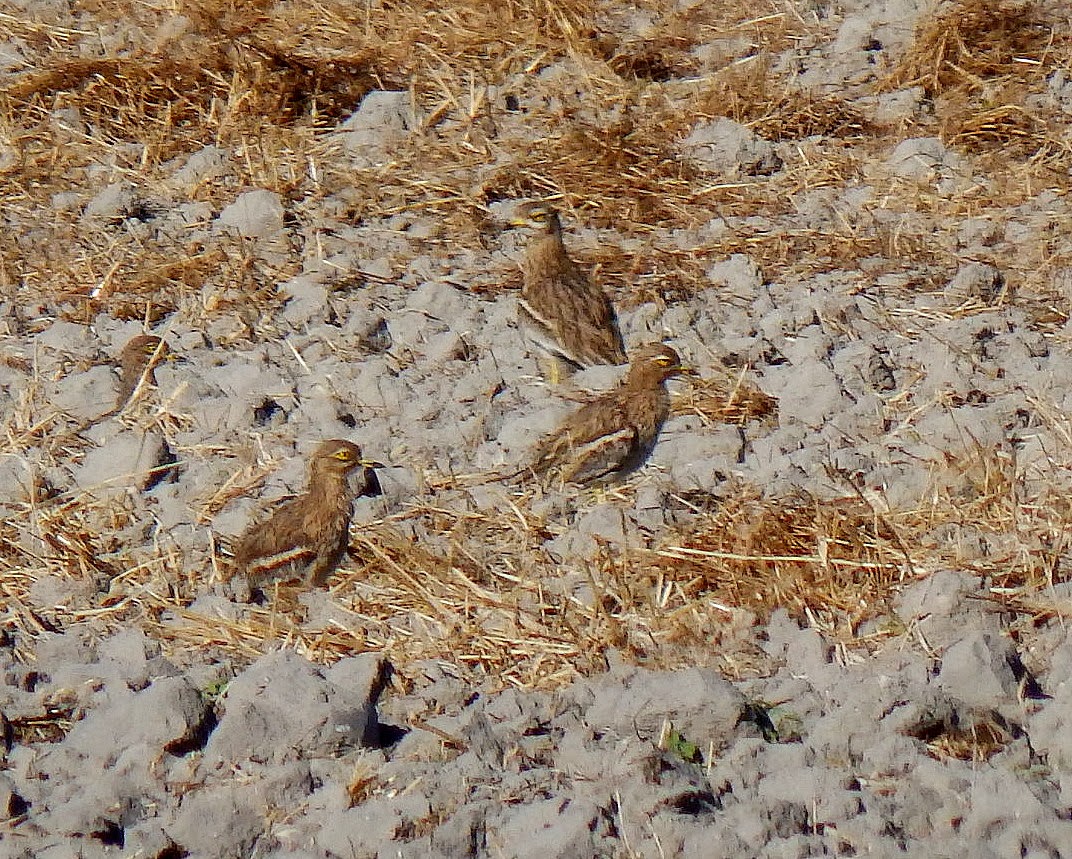 |
| 4 Stone Curlews |
But at least I'd had a very relaxing morning out and feel sufficiently fresh to face a week with my sister's presence, which means going birding again, and again, and again. What a life! I just hope the birding's up to it!
3/10/13
02 October : Sierra de María
The thought of Dave playing 'mummy' - frilly apron and all - is beyond my imagination! The mind really does boggle. What a good day you all had, I'm quite envious.
Before I start I have got to say what a great days birding we had today at the Sierra de Maria. Maybe not quantity, but quality. I won't go through the list of who was with Gilly and I, suffice to say there were 19 having coffee at the cafe before we headed towards the chapel. I logged a Black Redstart on the approach. Then, having sorted ourselves out, we began birding. Not a lot round the chapel itself, but we could see, despite the sun against us, that there were numerous birds hanging around the water trough. Sure enough there was a Spotted Flycatcher, Chaffinches, Rock and Cirl Bunting, Crossbill, a Jay and Blackcaps. I looked up into the poplar tree. I saw a perched chunky bird which I assumed, before I got my bins on it, to be a Crossbill, but no. It was a Hawfinch. As I, as silently as I could do, tried to attract the others attention, it flew, some catching a glimpse of it. We continued to observe the water trough. A Robin appeared as did a Serin. Just as I spotted a Pied Flycatcher, the shout went up that the Hawfinch was on the water trough hassling the Chaffinches, so everybody had good views.
Before I start I have got to say what a great days birding we had today at the Sierra de Maria. Maybe not quantity, but quality. I won't go through the list of who was with Gilly and I, suffice to say there were 19 having coffee at the cafe before we headed towards the chapel. I logged a Black Redstart on the approach. Then, having sorted ourselves out, we began birding. Not a lot round the chapel itself, but we could see, despite the sun against us, that there were numerous birds hanging around the water trough. Sure enough there was a Spotted Flycatcher, Chaffinches, Rock and Cirl Bunting, Crossbill, a Jay and Blackcaps. I looked up into the poplar tree. I saw a perched chunky bird which I assumed, before I got my bins on it, to be a Crossbill, but no. It was a Hawfinch. As I, as silently as I could do, tried to attract the others attention, it flew, some catching a glimpse of it. We continued to observe the water trough. A Robin appeared as did a Serin. Just as I spotted a Pied Flycatcher, the shout went up that the Hawfinch was on the water trough hassling the Chaffinches, so everybody had good views.
We then made our
way towards the Botanical Gardens only adding a solitary Griffon
Vulture and a vocal Blackbird to the list.
 |
| juvenile Golden Eagle |
Due to numbers the group was strung out over about 100 metres so I can
only report the sequence us at the front saw birds and add other reports
after. Small birds were few and far between, but we did see a Coal Tit and a Chiffchaff. Luckily another small group of Griffons passed
overhead or we wouldn't have seen the Alpine Swifts flying near to them.
We saw the odd Barn Swallow, but there were many House Martins high up
above the ridge. Someone spotted a pair of smaller raptors soaring and
basically mucking about at the far end of the ridge. A discussion took
place regarding the ID, which was confirmed later.......We saw more
Griffons. There were other raptors soaring above us. The Short-toed
Eagle was easy to spot. I said the other one was a dark phase Booted
Eagle. A couple of the others said no it was definitely a Golden Eagle.
Anyway the Short-toed and Booted came close together and you could
easily tell the size difference. But the what should appear flying
past but a Golden Eagle.....two different birds. And what was also
above. Those two smaller raptors....Sparrowhawks! On a high we headed
back towards the information centre. Mary, who'd been trying to do some
photography, had seen Great, Blue, Crested and Long-tailed Tits as
well as a Short-toed Treecreeper and Firecrests. Adrian had added a
Common Redstart.
It was then off
to the La Piza forest cafe for a coffee and a piece of Chocolate cake.
Gilly and I had won it at the Macmillan Coffee morning and decided to
share it with the group. Whilst I was being "mummy" cutting it it up,
numerous Crossbills were seen and another Hawfinch turned up for a
drink in the fuente.
 |
| Garden Warbler |
We then convoyed
down towards the plain, only adding a Carrion Crow at the farm
buildings. We added Rock Sparrow and a Green Woodpecker near the
watering hole. On the plain itself we only had Crested Lark and Northern
Wheatear.
It was then back
to the La Piza for lunch. As we ate a call went up for an unusually
marked bird. It turned out to be a Crossbill with a shadow across it. As I was checking it out I saw movement. A warbler: short stubby bill - a Garden Warbler that was surprisingly obliging, eventually coming down
to the fuente for a drink. The bird took our list to 41 species.
Still not 100%
happy with my camera/lens but did manage to get some shots today. Going
to spend the evening looking through the manual! The group photo below is from
last week's trip to the garnets taken by Ros Perkins. I'm sure the group
would also like to pass on our best wishes to Tony and Kas Scott who
are heading Malaga way in a few weeks time.
 |
| the Arboleas garnet hunters |
29/9/13
29 September : Guadalhorce
 |
| Spotted Flycatcher from terrace |
So, down to the Guadalhorce to have a look around I went, to see if there was anything interesting in the wader line in particular but all is grist to the mill but really everything was rather less than one might expect to see.
.JPG)
.JPG) Ducks were less in both number than variety than I would expect by this date. After all, one can hardly get overly excited about 3 Teal, 2 Shovelers and 2 Gadwalls as well as a few Pochards and aroud 10 White-headed Ducks (all of these on the laguna Escondida).
Ducks were less in both number than variety than I would expect by this date. After all, one can hardly get overly excited about 3 Teal, 2 Shovelers and 2 Gadwalls as well as a few Pochards and aroud 10 White-headed Ducks (all of these on the laguna Escondida).There were a few Barn Swallows and House Martins and a single Red-rumped but no big numbers and no swifts at all. There were the more Grey Herons, at least 15, and Cormorant figures had jumped to the dizzy height of 5 birds!
Raptors meant 1 each of Osprey (nice), Booted Eagle and juv. Marsh Harrier. Hardly overwhelming stuff, is it? And there were no migrant passerines at all to liven the morning, although a Kingfisher will brighten any scene, however briefly.
As for prime target, waders, I could hear at least three different Greenshanks from different points and moving around until finally a flock of 4 went up and flew around, gaining height, all the time calling and they were joined by 2 more and they all flew off up valley, with a single bird being seen later at the laguna Grande. The wader pond in front of the second hide along the east bank gave only 1 Stilt although in total there mist have been around 30 birds between the río Viejo and the laguna Grande, and the aforementioned Kingfisher!
The sea was flat calm and there were a few Yellow-legged Gulls, surprisingly not a single Lesser Black-backed, no Audouin's or Med. Gulls, and on the laguna Grande a Black-headed Gull still in full juvenile plumage, which is rather late.
Fortunately there were some waders, as well as 3 Flamingos, down on the río Viejo which went some way towards alleviating a not very great morning's birding but most were distant and against the light, which is always a pain (select own site for pain). So, I had to make do with a singles of Little Stint and Common Sandpiper, 3 Dunlins, some 8-10 Kentish Plovers playing see-me-if you-can, as did the similar number of Little Ringed Plovers and around 10 Sanderlings. And not even a rotten Redshank!
Not a good morning with around 36 spp. seen, although I must have missed something. And I've still got the translations to carry one with!
26/9/13
4-6 October: International Bird Day(s) events in Málaga
International Bird Day : 4, 5, and 6 October
These events are organised by SEO-Málaga. Obviously, the talks will be in Spanish but will be of some interest and it will enable those who are interested to make contact with Spanish birders. Sunday morning, when there will be ringing in progress, will probably interest many. I have given a brief summary in English of the page contents above each page shown below.
Remember to click on the images to enlarge them.
Hotel Vinnci, where the talks will take place, can be found by checking how to get there from where one lives on Google Earth or Michelin maps or similar.
Friday, 4 October: Hotel Vinnci at 19.00; talk on the status of Dupont's Lark in Andalucía, followed by a photographic projection of a trip to Patagonia.
Saturday, 5 October (continues on pages 2 and 3 with maps). Birds in Málaga city, a walk which takes in various areas such as the Alcazaba; also seawatching (see page 3)


Morning, seawatching from el Faro de Calaburras and el Peñón del Cuervo (maps below) and at 19.00, at the Hotel Vincci, a talk and photos of birds of Fuerteventura

 Sunday, 6 October: Guadalhorce, from 09.00 to 13.00. Note that it is possible to park near and enter by crossing the sandbar at the mouth of the river (unless there's a lot of rain on Saturday). Do NOT, under any
circumstances, park near the curve, but at the church or in fron of the
school. Break-ins are still taking place.The programme is below and below that a map of routes of entry and tracks to follow. I shall be there from around 09.00 onwards subtly disguised as a migrant Quebrantahuesos until I get bored or the knees self-destruct,
Sunday, 6 October: Guadalhorce, from 09.00 to 13.00. Note that it is possible to park near and enter by crossing the sandbar at the mouth of the river (unless there's a lot of rain on Saturday). Do NOT, under any
circumstances, park near the curve, but at the church or in fron of the
school. Break-ins are still taking place.The programme is below and below that a map of routes of entry and tracks to follow. I shall be there from around 09.00 onwards subtly disguised as a migrant Quebrantahuesos until I get bored or the knees self-destruct, Do come along, watch, see something (if you're lucky), learn a bit (if you're really lucky), meet real Spanish birders (there are some really good ones), many of whom will struggle with their English whilst you struggle with your Spanish. A field guide and binocs. are useful.
25 September : Nijar garnet Nature Walk
A Nature Walk indeed! Brings back memories - nice ones - of the primary school from the long unplumbed depths of the brain, doesn't it?
Gilly had a note excusing her today as she was teaching patchwork, so I'm writing this without her notes relying totally on my memory. This could go wrong on so many levels!
 At Ros's request we headed for the extinct volcanic rim
at Nijar where there are large deposits of sadly small garnets strewn
along the dried water courses. After a cuppa at the service station at
junction 487 we, that is myself and 12 other members, drove south to the
next exit (481). From there we drove carefully cross country on a
sometimes rough track to the parking area directly opposite the "Cuidad
del Motor". On the drive I spotted a Common Redstart and a Kestrel.
Having been here before I was able to show the group that there were
garnets in the car park!
At Ros's request we headed for the extinct volcanic rim
at Nijar where there are large deposits of sadly small garnets strewn
along the dried water courses. After a cuppa at the service station at
junction 487 we, that is myself and 12 other members, drove south to the
next exit (481). From there we drove carefully cross country on a
sometimes rough track to the parking area directly opposite the "Cuidad
del Motor". On the drive I spotted a Common Redstart and a Kestrel.
Having been here before I was able to show the group that there were
garnets in the car park!
 We then walked
through the sometimes narrow gorge into the central area of the volcano.
Above us on the ridge was a family of Black Wheatears and later a pair
of Blue Rock Thrushes. There were a few Barn Swallows and numerous Crested
Larks. A raptor soared above the opposite ridge. It was later identified
as a Bonelli's Eagle. A definite second bird was seen later as were a
pair of Booted Eagles. Sardinian Warbler and Greenfinch completed the list. Today wasn't about birds. The
Bonelli's Eagles were a huge bonus.
We then walked
through the sometimes narrow gorge into the central area of the volcano.
Above us on the ridge was a family of Black Wheatears and later a pair
of Blue Rock Thrushes. There were a few Barn Swallows and numerous Crested
Larks. A raptor soared above the opposite ridge. It was later identified
as a Bonelli's Eagle. A definite second bird was seen later as were a
pair of Booted Eagles. Sardinian Warbler and Greenfinch completed the list. Today wasn't about birds. The
Bonelli's Eagles were a huge bonus.
Today was about getting out in nature, somewhere different with birding friends. I think we all enjoyed the experience. Welcome to Les Senior, who we bumped into on last weeks Villaricos trip and joined us today. Thank you to Ros for suggesting today's outing. She & her husband Roger are going back to the UK till next year.
Hope I didn't miss too much out!
Gilly had a note excusing her today as she was teaching patchwork, so I'm writing this without her notes relying totally on my memory. This could go wrong on so many levels!
 We then walked
through the sometimes narrow gorge into the central area of the volcano.
Above us on the ridge was a family of Black Wheatears and later a pair
of Blue Rock Thrushes. There were a few Barn Swallows and numerous Crested
Larks. A raptor soared above the opposite ridge. It was later identified
as a Bonelli's Eagle. A definite second bird was seen later as were a
pair of Booted Eagles. Sardinian Warbler and Greenfinch completed the list. Today wasn't about birds. The
Bonelli's Eagles were a huge bonus.
We then walked
through the sometimes narrow gorge into the central area of the volcano.
Above us on the ridge was a family of Black Wheatears and later a pair
of Blue Rock Thrushes. There were a few Barn Swallows and numerous Crested
Larks. A raptor soared above the opposite ridge. It was later identified
as a Bonelli's Eagle. A definite second bird was seen later as were a
pair of Booted Eagles. Sardinian Warbler and Greenfinch completed the list. Today wasn't about birds. The
Bonelli's Eagles were a huge bonus. Today was about getting out in nature, somewhere different with birding friends. I think we all enjoyed the experience. Welcome to Les Senior, who we bumped into on last weeks Villaricos trip and joined us today. Thank you to Ros for suggesting today's outing. She & her husband Roger are going back to the UK till next year.
Hope I didn't miss too much out!
22/9/13
21 September . Fuente de Piedra and a cash appeal
Yesterday' morning's brief visit was more to see Chris Feare who has returned from yet another season in the Seychelles of 40 years studying the Sooty Terns - also colloquially known as Wideawakes because of the noise they make, measured out at 107 decibels Chris tells me, so they'd keep most of Málaga province awake.
With the advent of modern technology, the results that he is obtaining using only geolocators are incredible and show that birds from the Seychelles wander as far as the northern end of Madagascar, to western Australia and to the Bay of Bengal and off western of India. However, as geolocators have their drawbacks (basically an inherent inaccuracy in some cases), Chris is searching for financing to put GPS satellite tracking transmitters on the some Sooty Terns next year. Modern technology and GPS satellite tracking are very expensive but enable birds to be tracked in real time and anyone with a spare 5.000 pounds sterling (or anything lesser provided that it has 4 digits) can contact Chris through myself and help finance next year's even more advanced work and feel that they are doing something really useful with their spare cash.
We did, of course, do some birding (which I know will surprise you greatly) and although the light is always bad in the morning when overlooking the lake at the back. However, the lake has shrunk even more and so have the number of birds. There were a couple of Avocets, a Spotted Redshank and some Ringed and/or Little Ringed Plovers. The commonest wader by far, with a guesstimated 30+, was Little Stint but the light precluded seeing if any were disguised as Temminck's Stints.
The laguna itself is still chock-full of those pinky things whose name evades me for the moments and there were Gadwall, Shoveler and Black-necked Grebes out on the water. A small flock of 6 Shelducks did a flypast - very smart.
We did see a pair of Booted Eagles slowly circling their way westwards but there was a rather notable lack of passerines with the wind keeping them well down in the bushes but we did see a nice Whinchat, my first of this autumn, and when a couple of tractors started disc-harrowing the Stone-curlew field (the one where the tower is) a bundle of Barn Swallows started feeding over the disturbed insects, although how they managed to see them through the clouds of dust is obviously a mystery.
So, just a short entry and do take a look at the piggy bank!
With the advent of modern technology, the results that he is obtaining using only geolocators are incredible and show that birds from the Seychelles wander as far as the northern end of Madagascar, to western Australia and to the Bay of Bengal and off western of India. However, as geolocators have their drawbacks (basically an inherent inaccuracy in some cases), Chris is searching for financing to put GPS satellite tracking transmitters on the some Sooty Terns next year. Modern technology and GPS satellite tracking are very expensive but enable birds to be tracked in real time and anyone with a spare 5.000 pounds sterling (or anything lesser provided that it has 4 digits) can contact Chris through myself and help finance next year's even more advanced work and feel that they are doing something really useful with their spare cash.
We did, of course, do some birding (which I know will surprise you greatly) and although the light is always bad in the morning when overlooking the lake at the back. However, the lake has shrunk even more and so have the number of birds. There were a couple of Avocets, a Spotted Redshank and some Ringed and/or Little Ringed Plovers. The commonest wader by far, with a guesstimated 30+, was Little Stint but the light precluded seeing if any were disguised as Temminck's Stints.
The laguna itself is still chock-full of those pinky things whose name evades me for the moments and there were Gadwall, Shoveler and Black-necked Grebes out on the water. A small flock of 6 Shelducks did a flypast - very smart.
We did see a pair of Booted Eagles slowly circling their way westwards but there was a rather notable lack of passerines with the wind keeping them well down in the bushes but we did see a nice Whinchat, my first of this autumn, and when a couple of tractors started disc-harrowing the Stone-curlew field (the one where the tower is) a bundle of Barn Swallows started feeding over the disturbed insects, although how they managed to see them through the clouds of dust is obviously a mystery.
So, just a short entry and do take a look at the piggy bank!
Suscribirse a:
Entradas (Atom)


